
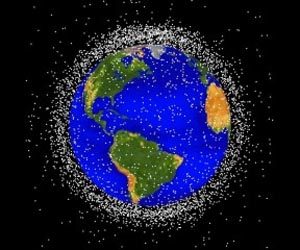
Russia's Rocket and Space Corporation Energia announced Tuesday that it will build a special orbital pod designed for sweeping-up the near-Earth space from satellite debris.
The system was estimated to cost about 60 billion rubles (1.9 billion U.S. dollars).
Every year, the near-Earth space becomes more and more densely populated with used satellites and their debris, said the company.
"The corporation promised to clean up the space in ten years by collecting about 600 defunct satellites on the same geosynchronous orbit and sinking them into the ocean subsequently," said Victor Sinyavsky from the company as quoted by the Interfax news agency.
He said the cleaning satellite would work on nuclear power and be capable to work up to 15 years.
Energia said that the company would complete the cleaning satellite work-out and assembly by 2020 and test the device no later than in 2023.
Sinyavsky said that Energia has also been drafting a space interceptor designed to destroy dangerous space objects heading toward the Earth.
World Space Agencies To Jointly Explore Solar System
Moscow (XNA) Nov 24 – International space agencies have agreed to cooperate over the exploration of solar system using unmanned spacecraft, said Russian federal space agency Roscosmos on Monday.
"Universal understanding of the birth and the development of our Solar System … has widened significantly with the beginning of the space era, which gave us an opportunity to see everything through the eyes of automatic research equipment," Roscosmos said in a statement published on its website.
Countries were not likely to achieve any palpable results if they worked separately, said the statement, which came as a result of the recent meeting between 25 space agencies in Washington, the United States, on Nov. 17.
Further international cooperation in space sector was viewed in four main directions: manned space flights, climate change control, emergency situations monitoring and space exploration using unmanned spacecraft, said the statement.
Share This Article With Planet Earth
