
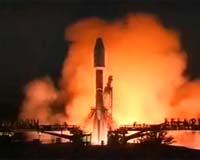
The chief of Russia's space agency said Monday Russia would launch a spacecraft for the United Arab Emirates (UAE) in 2008 from the launch site in Kazakhstan. "We plan to launch a remote sensing satellite for the UAE in 2008," Anatoly Perminov said, adding that a related agreement had been signed on the sidelines of President Vladimir Putin's first visit to the Arab state.
Perminov said he hoped agreement with Kazakhstan, which suspended Russian Proton booster launches from the Baikonur space center following a crash early Thursday, would be reached within a month.
"I believe we will resolve the issue within a month," he said.
A Proton-M booster carrying a Japanese satellite exploded shortly after liftoff and came down in the central Kazakh steppe. The rocket was carrying highly toxic fuel, and an investigative team is yet to determine the scale of possible environmental damage.
Russia and Kazakhstan have an agreement on launches from Baikonur until 2050, for which Moscow pays Astana $115 million a year. But Kazakhstan recently said it would reconsider allowing further Proton flights because of the rocket fuel's toxicity and potential for catastrophic environmental contamination in the event of a launch failure.
Source: RIA Novosti
related report
UAE satellite telecom firm to launch 3rd satellite on Oct. 28
Thuraya, a satellite telecom firm in the United Arab Emirates (UAE), will launch its third satellite into orbit on Oct. 28 to expand its capacity and coverage area, local newspaper Gulf News reported on Monday.
The Thuraya-3 satellite is part of the company's plans to expand coverage to countries in the Asia Pacific region, including China, Japan, Korea, Malaysia, Vietnam, Indonesia, the Philippines and Australia, the report said.
After the launch of the satellite, Thuraya plans to start commercial services in the Asia Pacific region by Dec. 23, the company's CEO Yousuf Al Sayed said.
Established in 1997, Thuraya launched its first satellites from the Pacific Ocean in 2000 and the second in 2003.
The Abu Dhabi-based company currently has a share of some 26 percent in the global mobile satellite market, providing mobile satellite services for over 110 nations and regions across the Middle East, Europe, Africa and Asia.
Source: Xinhua News Agency
