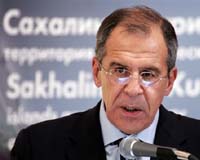
Russian officials on Wednesday hammered foreign firms developing the massive Sakhalin-2 oil and gas project at a tense international investor conference in Russia's Far East. Controversial environmental checks on the Shell-led project "are based exclusively on the demands of the law," Russian Foreign Minister Sergei Lavrov told some 300 investors gathered on the energy-rich island of Sakhalin.
"The idea that foreigners are being pushed out of the Russian energy market has no basis," Lavrov said, responding to claims that increased checks are part of a Kremlin bid to strengthen control over Russia's vast natural resources.
Another official, Konstantin Pulikovsky, head of the state industrial monitoring agency, said at the conference that the project violated a number of rules on industrial safety and "this worries our inspectors."
Russia's natural resources ministry wants environmental authorisation revoked for the 20-billion-dollar (15.8-billion-euro) project, which also involves Japanese firms Mitsui and Mitsubishi.
Investigations into the operation of Sakhalin-2, which is one of the largest energy projects in the world and is aimed at exports to Asian energy markets, have sparked a chorus of international protest, although environmental organizations have said they are justified.
Russian government action was "one-sided, unilateral" and "lacks procedural transparency", Yasuo Saito, Japan's ambassador to Moscow, said at the conference.
"The international community is paying special attention to the future of this project," Saito said, adding that Russia was expected to play an "active and constructive role".
Japan is just 40 kilometres (25 miles) south of Sakhalin and Japanese utilities have already bought future contracts for liquefied natural gas (LNG) from the project, with deliveries expected to start in 2008.
Ian Craig, head of the Sakhalin-2 consortium, defended its environmental record and told reporters it was "quite possible" the dispute was linked to attempts by Russian state gas monopoly Gazprom to buy into the project.
Total losses from a hypothetical one year delay in the project would be around 10 billion dollars and "the greatest damage of all by far would be the damage to Russia's reputation as a reliable energy supplier," Craig said.
Sakhalin, a former Tsarist prison colony some 1,000 kilometres long that is shaped like a giant shard of ice, is estimated to have the equivalent of 45 billion barrels of oil.
Environmental campaigners and some inhabitants of this pristine island located seven time zones east of Moscow say it is time that foreign oil majors start respecting the rules and provide more benefits for ordinary Russians.
International organizations including Greenpeace and the World Wildlife Fund have joined the Russian government in slamming environmental violations by the foreign firms running the project.
For energy analysts, behind-the-scenes business sparring between Sakhalin-2 executives on the one hand and Gazprom and the Russian government on the other is now becoming an open battle for control.
Valery Garipov, a former Russian energy minister who is now at the Russian Chamber of Commerce, appeared to confirm this Wednesday when he said the problem with Sakhalin-2 is that "it's not Russian."
Gazprom should be "quickly" included in the project, he added. Shell owns a 55 percent stake in Sakhalin Energy, while Mitsui and Mitsubishi hold 25 percent and 20 percent respectively.
Talks with Gazprom over the purchase by the Russian monopoly of some 25 percent in the project stalled last year after Sakhalin-2 officials announced a doubling of the cost of the project to 20 billion dollars.
The cost increase sparked Russian government anger since under the consortium's production sharing agreement the state will only receive a share of profits after the group recoups its investments.
Rosneft, another energy firm controlled by the Russian state that is developing the Sakhalin reserves leads three other projects in Sakhalin — Sakhalin-3, Sakhalin-4 and Sakhalin-5.
Sakhalin-1 is operated by a consortium led by ExxonMobil and is scheduled to make its first oil deliveries next week, though Pulikovsky warned further checks would be needed on the project's industrial safety record.
dt/ch/ns
Source: Agence France-Presse