
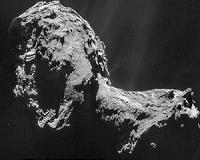
The European Space Agency's Rosetta spacecraft has found the water vapor from comet 67P/Churyumov-Gerasimenko to be significantly different from that found on Earth. The discovery fuels the debate on the origin of our planet's oceans.
The measurements, by the Rosetta Orbiter Spectrometer for Ion and Neutral Analysis (ROSINA) instrument, were made in the month following the arrival of the spacecraft on Aug. 6. It is one of the most anticipated early results of the mission, because the origin of Earth's water is still an open question.
Comets are time capsules containing primitive material left over from the epoch when the sun and its planets formed. Rosetta's lander obtained the first images taken from a comet's surface and will provide analysis of the comet's possible primordial composition.
Rosetta will be the first spacecraft to witness at close proximity how a comet changes as it is subjected to the increasing intensity of the sun's radiation. Observations will help scientists learn more about the origin and evolution of our solar system and the role comets may have played in seeding Earth with water, and perhaps even life.
