
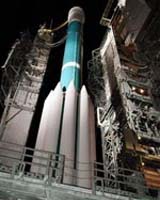
For the 207th time — and counting — an RS-27 booster rocket engine, built by United Technologies' Pratt and Whitney Rocketdyne has powered satellites into space. This time it was the pairing of CloudSat and CALIPSO, which were launched today from Vandenberg Air Force Base and will provide a new, more intense look at the Earth's atmosphere.
The RS-27 has built a 100-percent flight success record over more than three decades. Rated at 200,000 pounds of thrust (sea level), the RS-27A version of the engine is used on all five variations of the Delta II family. Working with combinations of strap-on solid rocket boosters, the engine can lift payloads of nearly 6,000 pounds to more than 10,000 pounds into low-earth orbit.
"Today's flawless performance of the RS-27A engine is a reflection of the continuing dedication and professionalism of the entire RS-27A PWR team," said Elizabeth Jones, program manager for the engine. "I'm fortunate and thrilled to be a part of this team. We're looking forward to a very busy time supporting 10-plus launches in 2006 and 2007."
Among the many missions boosted by the RS-27 are GPS, Mars Pathfinder, Mars Global Surveyor, Deep Impact and Stardust. In addition, the Mars Rovers "Spirit" and "Opportunity" — still working on the Red Planet — were sent on their way by the RS-27A.
