
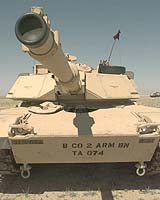
As 572 new Abrams and Bradley fighting vehicles, 300 LRAS3 (Long Range Advanced Scout Surveillance Systems) and other Army ground platforms roll out, all will be equipped with upgraded "night vision" sights produced by Raytheon.
Using $180 million in follow-on funds, the company will give the Army's M1A1 vehicle fleet a new generation of sensors under a one-year contract that was driven by "lessons learned" during the Middle East conflict.
The award clears the way for Raytheon to produce 1,603 Block 1 B-Kits and 252 Abrams M1A2 A-kits to update the vehicles with the latest in forward- looking infrared (FLIR) systems.
The Block 1 effort, also known as "Second Generation FLIR" (SGF), is fully funded and Raytheon expects further Block 1 SGF awards in 2006.
Using FLIR technology, warfighters can view the battlefield 24/7, in all weather and wartime conditions including rain, smoke, sandstorms, fog and dust. Compared to first generation FLIR systems on older M1A1s, the Block 1 upgrade will double the distance at which troops can identify a target and increase the distance at which a gunner can "lock-on" to a target.
The greater the identification range, the more accurately American war fighters can engage enemy platforms and avoid fratricide.
"Second generation FLIR is often listed as the first or second priority for Army combat vehicle technology upgrades," said Glynn Raymer, vice president of Raytheon Combat Systems.
"The Block 1 SGF program not only offers significant improvements in cost, size, weight and power, but also the technology integration effort will advance the Army's transition to a modular force, provide improved performance and increase sensor commonality across the vehicle fleet."
The company will provide the same, or similar, systems for the U.S. Marine Corps, key international partners and U.S. Army government-furnished equipment.
