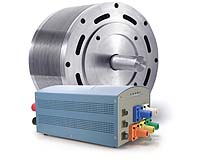
Raser Technologies has signed a Cooperative Research and Development Agreement with the U.S. Army's National Automotive Center and their Tank Automotive Research Development and Engineering Center to explore common interests in ground vehicle applications of the components, designs, and technology associated with high performance electro-magnetic equipment, especially in hybrid electric vehicle uses.
As part of the CRADA, TARDEC and Raser will investigate the possibility of using an integrated starter alternator ("ISA") in military vehicles, using Raser's motor technology as an ISA in the Army's "Humvee", and using Raser's motor and controller technology in non-ISA applications in military vehicles.
Under the Agreement, the parties will share engine/vehicle design specifications for multiple vehicles, and document testing/performance parameters of the motors, controllers and ISAs.
"We are confident that the CRADA framework will accelerate the evaluation and adoption of Raser's Symetron technologies in military, and ultimately consumer vehicle applications," said Raser CEO Brent M. Cook.
"Execution of the CRADA is a significant milestone for Raser in that it establishes our long-term working relationship with the U.S. Army and provides for the intellectual property protection that we require."
A CRADA is a written agreement between a company in private industry and a government agency to work together on a project. Created as a result of the Stevenson-Wydler Technology Innovation Act of 1980, as amended by the Federal Technology Transfer Act of 1986, a CRADA allows the Federal government and non-Federal partners to optimize their resources, share technical expertise in a protected environment, share intellectual property emerging from the effort, and speed the commercialization of federally developed technology. A CRADA is an excellent technology transfer tool. It can:
Provide incentives that help speed the commercialization
of federally-developed technology.
Protect any proprietary information brought to the CRADA effort by the partner.
Allow all parties to the CRADA to keep research results
emerging from the CRADA confidential and free from disclosure
through the Freedom of Information Act for up to 5 years.
Allow the government and the partner to share patents and patent licenses.
Permit one partner to retain exclusive rights to a patent or patent
license.