
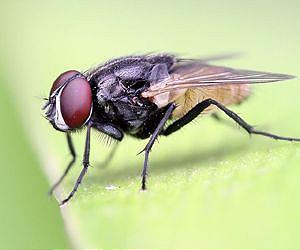
A continuous, self funded research effort begun in Oregon in 1975 has resulted in a mature system for the intensive farming of Musca domestica, the Common Housefly. Fly Farm Systems has a patent pending on the techniques and apparatus of its proprietary insect husbandry system. The firm is seeking to license partners for application world wide.
The firm's insectary grow beds commonly yield seventy pounds of clean larvae per square foot per year. A variety of organic materials and agriculture wastes can be used as grow medium.
Among possible setups this system can be utilized as part of a cleansing cycle for poultry barns. Both the spent growth medium and the fecal wastes of the insects themselves have application as fertilizer. Recent developments allow for greatly increased production over earlier laboratory scale yields.
Our associated firm, Oregon Feeder Insects Corporation, has for twenty five years developed food products for avian and aquatic use in private and public animal collections. Institutional applications have supported nerve and optical studies, water absorption in farmed fish, and pollination.
Potential applications also exist in fine oils and cosmetics. Our various insect based diets or supplements are used in wildlife rehabilitation, cage bird propagation, wild bird food and, most recently, all natural (not organic) poultry boosters, mimicking free range diet, to enhance egg production and quality. The various applications have utilized live, dehydrated and frozen larvae and pupae either whole, ground, pelleted and liquefied.
Initial palatability experiments point to a successful application in human nutrition. Early efforts in this direction have been limited to novelty foods. Processing the large volumes of insect material that will become available will allow for many human food applications. Musca domestica will be grown and harvested for human food on Mars long before any traditional livestock will be attempted on that planet.
Until then, in its position as the most productive agricultural process known, the culture and utilization of this insect holds real promise in relieving pressure on traditional animal based nutrient resources and wild populations on Earth.
Share This Article With Planet Earth
