
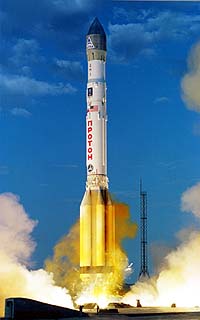
Preparations for the launch of a Proton-K carrier with two Yamal-200 communication satellites aboard have begun at Baikonur the Russian news agency Itar-Tass reported Monday.
The launch is scheduled for November 20. The Briz-KM booster will put the satellites into geostationary orbit.
Final checks are now in process on the carrier rocket and the two satellites. They will be assembled into one block on November 6.
"As of now, all operations to prepare for the launch are being carried out in accordance with the approved schedule," the press service of the Space Forces reported.
Proton-K is a liquid fuel four-stage rocket with an overall take-off weight of about 700 tonnes.
The Yamal-200 satellites will be used to support expansion of the satellite communication network created for Russian booming gas industry. During his recent visit to the Mission Control Centre, Interior Minister Boris Gryzlov said law-enforcement agencies will use space technologies in order to fight crime more effectively.
The satellites will also be used to assit law-enforcement agencies gather information about illegal siphoning of gas and oil from pipelines and illegal oil drilling rigs.
They will also make it possible to monitor unguarded sections of the state border and watch the movement of groups of illegal migrants and smugglers.
In addition, the new satellite system will allow police to control patrol cars and direct them to the scene of the crime in an on-line mode. Its use has already helped detain a law offender.
Police will also be able to monitor the situation in the streets 24 hours a day. A special electronic map shows all key facilities and the most crime-prone places, which will be constantly watched by the duty officer. In the near future, the system will be able to read the number plates of automobiles that have been stolen and used by law offenders.
"If any of the cameras catches the number, the system will quickly determine who is the owner of the car and his address," designers explained to Gryzlov.
The minister commended the work and said the system was already operating in Omsk, Tyumen.
