
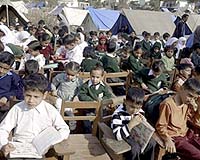
Hundreds of earthquake victims in Pakistani Kashmir have acute diarrhoea and doctors are investigating whether they are cases of cholera, the World Health Organisation and the United Nations said Wednesday.
Aid workers are urgently trying to improve water supplies and sanitation at the cramped refugee camps where the survivors fell sick in the devastated regional capital Muzaffarabad, WHO technical officer Rachel Lavy told AFP.
"In one camp we visited yesterday there were 55 cases of diarrhoea and there are so many spontaneous camps that we believe there are hundreds of others," Lavy said as she headed to one of the camps.
"Acute watery diarrhoea fits very closely with the definition of cholera. That is one of the things it can be," Lavy said, adding however that there were other waterborne diseases that could cause similar types of diarrhoea.
"We are treating it as suspicious but we don't have laboratory guidance at this stage," she said.
The United Nations has repeatedly warned it is racing against time and a shortage of international aid cash to prevent a possible second wave of deaths from disease, cold and hunger after the October 8 disaster.
"The WHO is saying that even if the laboratory diagnosis is not confirmed, these cases should be taken as seriously as if they were cholera," said UN spokeswoman Amanda Pitt.
She said a small number of acute diarrhoea patients had been reported from other towns in the quake zone in recent weeks and that outbreaks of disease were "not unexpected."
Lavy said there were 40 other cases recorded last week in Chinari, a small town in Pakistani Kashmir.
British charity Oxfam warned last week that the squalid conditions in the camps could kill thousands of people, far exceeding the toll in remote villages that have been the focus of aid efforts so far.
More than 7,000 cases of diarrhoea — not all of them acute — and 8,000 cases of respiratory disease had been reported in the quake zone, top Pakistani health ministry official Anwar Mahmood told AFP.
"We are monitoring the situation daily," he said.
Acute diarrhoea can be fatal if it is not treated aggressively and immediately, the WHO's Lavy said.
"It can deyhdrate an adult within a few hours," she added. "If you get watery diarrhoea you need to treat it aggressively with massive rehydration, isolation, ensuring clean water and sanitation to prevent contamination."
But she said that curbing the spread of illness was especially difficult in the densely populated tent camps that have sprung up in Muzaffarabad.
"The spontaneous camps are not set up by the government and are not organised, so inevitably water and sanitation are not good," she said. "Now we are going to visit as many of the camps as we can."
Lavy said disease outbreaks were "almost inevitable" after a major disaster like the quake, adding: "You are fighting a battle against time and now diarrhoea has come we have to try to prevent it spreading."
The 7.6-magnitude earthquake is confirmed to have killed nearly 74,000 people in Pakistan and more than 1,300 in India. However humanitarian groups estimate the toll to be 86,000 in Pakistan.
