
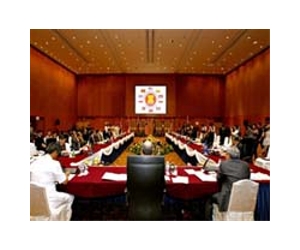
Philippine President Benigno Aquino urged Southeast Asian countries Thursday to present a united front to China over the South China Sea at an upcoming regional summit.
Aquino said all 10 members of the Association of Southeast Asian Nations should speak with one voice at the East Asia summit in Cambodia next week.
"We can talk to the other claimants that aren't ASEAN members but since we want to maintain ASEAN's centrality, we must have just one voice in ASEAN… in this regard," he told reporters.
He noted that ASEAN included four countries with some overlapping claims to islands and waters in the South China Sea — the Philippines, Brunei, Malaysia and Vietnam. Non-members China and Taiwan also have their own claims.
ASEAN also includes Cambodia, Indonesia, Laos, Myanmar, Singapore and Thailand.
China insists it has sovereign rights to nearly all of the South China Sea despite the competing claims of the four ASEAN members to parts of the waters.
In July a regional ministerial meeting in Phnom Penh ended in disarray over the issue.
ASEAN chair Cambodia, a close China ally, refused to allow Vietnam and the Philippines to mention specific disputes with China over the sea, preventing the group from issuing a joint communique for the first time in its 45-year history.
Aquino said he hoped other countries outside of ASEAN realised it was necessary to maintain stability in the South China Sea for the region's growth to continue.
Tensions over the sea have risen in recent months, with Beijing becoming embroiled in diplomatic rows with Manila and Hanoi.
Japan wants 'mutually beneficial' relations with new China
Tokyo (AFP) Nov 15, 2012 –
Japan said Thursday it wants to develop "mutually beneficial" relations with China's new leaders, as the two countries remain embroiled in a dispute over islands in the East China Sea.
The sovereignty row is affecting the huge trade ties between the region's two biggest economies and shows little sign of being resolved.
Relations between the two capitals are some of the "most important… for Japan and China and for the whole world", said the foreign ministry's deputy press secretary Naoko Saiki.
"We really hope that the mutually beneficial relationship based on common strategic interests will be further developed and enhanced with the new leadership" of China, she said.
Saiki was speaking hours after China's all-powerful Communist Party unveiled a new seven-man leadership council steered by Xi Jinping to take command of the world's number two economy for the next decade.
Xi told party apparatchiks gathered in Beijing's Great Hall of the People he would fight official corruption and build a "better life" for the nation's 1.3 billion people.
Relations between China and Japan are often volatile, in part as a result of their bloody history.
Beijing says Tokyo has failed to atone for its brutal expansionism and occupation in the 1930s and 1940s, while Japan maintains it is time to move on from events more than six decades ago.
The pair have a huge trade relationship, worth well in excess of $300 billion a year. China is Japan's single biggest trading partner despite a number of intractable sticking points.
The long-rumbling row over who owns the Tokyo-controlled Senkaku islands, which Beijing claims under the name Diaoyus, flared again in September when Japanese Prime Minister Yoshihiko Noda nationalised three of them.
Noda wanted to avert the purchase of the outcrops by the fiercely-nationalist then-Tokyo mayor Shintaro Ishihara.
The prime minister had calculated that Ishihara's plan to develop the rocks was inflammatory, and he hoped to take the heat out of the row.
But Beijing reacted with fury, allowing large and sometimes violent street protests in cities across the country that left some Japanese businesses in ruins.
A Chinese consumer boycott of Japan-brand goods has left the likes of auto giant Nissan licking its wounds and forecasting a large drop in sales in the world's largest car market.
Chinese state-run ships have since been sent to waters around the islands, where they have faced off against Japan's well-equipped coastguard fleet.
The confrontations have so far been limited to radio exchanges, with both sides warning the other to leave their territorial waters.
But commentators say the situation could escalate quickly if either side makes a mistake.
