
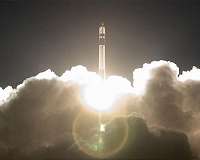
Rocket Lab's Electron rocket lifted off Monday AUg 19, at approximately 6 a.m. MDT. Onboard the rocket was Pearl White, an Air Force Space Command demonstration program consisting of two 6U cubesat experimental spacecraft.
The program goal is to design, develop, launch and operate two 6U cubesat experimental spacecraft as an on-orbit testbed for emerging technologies in 2019.
The demonstration will test new technologies including propulsion, power, communications, and drag capabilities for potential applications on future spacecraft. The spacecraft will be in Low Earth Orbit (LEO) with a notional altitude of ~540 km and an inclination of ~45 degrees.
The two cubesats were built by Tiger Innovations Inc., which is located in Herndon, Va., and are designed for a one-year lifetime. Tiger Innovations Inc. will operate the spacecraft for the life of the program under the direction and oversight of AFSPC.
Rocket Lab Mission Overview
Rocket Lab's eighth mission lifted-off on 19 August UTC from Launch Complex 1 in New Zealand, carrying a total of four satellites aboard an Electron launch vehicle.
On board were satellites destined to begin a new constellation for UNSEENLABS, as well as more rideshare payloads for Spaceflight, consisting of a spacecraft for BlackSky and the United States Air Force Space Command.
The mission launched a CubeSat that formed the cornerstone of a new maritime surveillance constellation for French company UNSEENLABS. The constellation aims to deliver precise, reliable, and secure maritime data, enabling organizations to monitor their own vessels and observe those that present risks, such as pirates and illegal vessels.
Mission management and rideshare aggregator, Spaceflight, also manifested three satellites on its second rideshare mission with Rocket Lab. Among the rideshare payloads was BlackSky's Global-4 Earth-imaging satellite.
The satellite joined BlackSky Global-3, which was launched to low Earth orbit on an Electron vehicle in June 2019. BlackSky's constellation delivers rapid-revisit satellite imagery to assist with monitoring economic activity such as crop development and herd migration, or surveying damage following natural disasters.
The final spacecraft manifested on the mission were two experimental satellites for the United States Air Force Space Command, designed to test new technologies including propulsion, power, communications, and drag capabilities for potential applications on future spacecraft.
