
Iraqi politicians on Monday extended an inaugural parliamentary session by two weeks to give rival blocs more time to form a government, more than four months after an inconclusive poll.
"The leaders of the political parties met today but they did not find a solution so they decided to extend the session by two weeks," a parliamentary official said, alluding to a July 14 deadline for parliament to reconvene.
The parliament, the second democratically elected chamber since the fall of dictator Saddam Hussein, met briefly for the first time on June 14 after the March 7 general election, before going into recess.
Under the conflict-wracked country's new constitution, there was a one-month deadline from that date for members to reconvene.
However, a decision on when parliament meets has been overshadowed by a lack of progress on forming a new government, including who becomes Iraq's new prime minister.
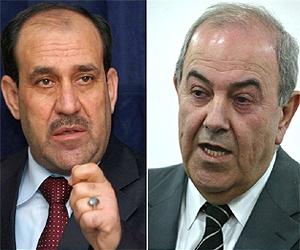
Iyad Allawi, a Shiite former premier, insists that as the election's narrow victor he should become prime minister, especially as his broadly secular Iraqiya coalition had strong backing in Sunni-dominated provinces.
He has warned that failure to have Sunni Arab voters properly represented in power could reignite the sectarian violence which saw tens of thousands killed in the first years after Saddam's ouster.
Allawi narrowly pushed serving Prime Minister Nuri al-Maliki's Shiite-led State of Law alliance into second place in the election, but the incumbent is doggedly fighting to stay on and serve a second term.
Jamal al-Battkh, a prominent member of Allawi's Iraqiya list, said the need for a two-week extension reflected the lack of political progress. "Four months have passed and we are moving in circles," he said.
"Now we extend for weeks and all we speak about is the constitution, but we are not implementing the constitution," he added, referring to how the 30-day deadline for parliament to reconvene had been sidestepped.
More Iraq News
British govt 'exaggerated' Iraq WMD claims: ex-diplomat
London (AFP) July 12, 2010 –
Britain and the United States did not believe Iraq's weapons of mass destruction posed a "substantial threat" before they launched military action, a former British diplomat said Monday.
Carne Ross told the inquiry into the 2003 invasion that the British government "intentionally and substantially" exaggerated its assessment of the weapons capability of Saddam Hussein's regime.
There was no "significant intelligence" to back up the British government's belief that Iraq had weapons of mass destruction (WMD), Ross added.
Ross, who was First Secretary responsible for the Middle East at Britain's mission to the UN from 1997 to 2002, alleged that complex intelligence was "massaged" into "more robust and terrifying" statements about Iraq's supposed weapons programme.
He said in a statement to the inquiry: "It remains my view that the internal Government assessment of Iraq's capabilities was intentionally and substantially exaggerated in public Government documents during 2002 and 2003.
"Throughout my posting in New York, it was the UK and US assessment that while there were many unanswered questions about Iraq's WMD stocks and capabilities, we did not believe that these amounted to a substantial threat."
He said that "at no point" was there "firm evidence" that Iraq was in possession of significant stocks of weapons.
"Most of the unanswered questions derived from discrepancies in Iraq's accounting for its past stocks and the destruction of these stocks," he added.
When no WMD were found in Iraq, Britain faced questions about the intelligence used to make the case for war, including a key September 2002 dossier which claimed Saddam could launch WMD within 45 minutes.
It has since emerged this claim referred to battlefield weapons.
When former British prime minister Tony Blair gave evidence to the inquiry earlier this year, he admitted the claim should have been "corrected" but insisted that going to war had been the right decision.
Share This Article With Planet Earth
