
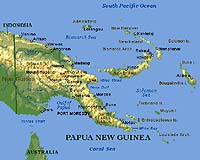
Papua New Guinea's government said Monday it had sent food and water to drought and frost-hit regions, as it warned a current dry spell could be the worst in decades.
Prime Minister Peter O'Neill said the poverty-stricken Pacific nation, where many are dependent on subsistence agriculture, should prepare for conditions to deteriorate.
"This drought has the potential to be worse than 1997 and 1998," he said in a statement, referring to a devastating period in which some 500 people are thought to have died from diseases spawned by a prolonged drought.
O'Neill said the government was preparing for "the possibility of an extended drought with related frost, made worse due to the affects of climate change".
"Currently 1,842,000 people have been affected by this extreme weather, of which 1,303,000 are classed as being in the most at risk, category 4, drought," he said.
The government has initiated a programme to deliver relief to affected communities and monitor those most at risk. No fatalities have so far been reported.
O'Neill said high altitude areas in five highlands provinces, as well as several other areas, had been badly affected by frost destroying food gardens.
"As an immediate response, the national government is delivering food and water to affected areas, as well as healthcare support," he said.
"Where appropriate, schools are being directed to reduce their operating hours or to temporarily close."
O'Neill said the government's response would differ depending on the staple food of each region, with four technical assistance teams mobilised to make assessments.
"Provinces where sweet potatoes… is the staple will be severely affected due to drying soil and the potential of frost damage," the prime minister said.
"Provinces which depend on sago and banana will be less affected in relation to food production, but pressure will mainly be placed on their water sources."
The government said 54 tonnes of rice had been sent to the highlands region of Mount Hagen as initial supplies, with 52 tonnes of flour and cooking oil also earmarked.
