
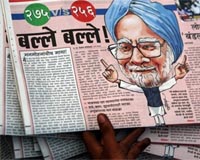
It appears India and the United States started a mutual "nuclear tango" during the July 7-9 summit of the Group of Eight major industrialized nations at the Toyako resort area in Hokkaido, Japan. Under the proposed deal, New Delhi will gain access to U.S. uranium and nuclear technology with potential military applications.
Indian Prime Minister Manmohan Singh has told U.S. President George W. Bush that his government is ready to railroad the 2007 U.S.-Indian nuclear energy cooperation agreement through the Indian Parliament.
Singh also negotiated this issue in Hokkaido with Russian President Dmitry Medvedev and Chinese President Hu Jintao, because Moscow and Beijing are members of the Nuclear Club, the U.N. nuclear watchdog International Atomic Energy Agency and the Nuclear Suppliers Group.
Although it takes two to tango, the U.S.-Indian "nuclear tango" is something special, because at least four other partners are waiting for Washington and New Delhi to take the first step. Russia is among them, but it is not worried about India's possible involvement in the U.S. nuclear program.
Moscow will have to compete against the United States on uranium markets.
If the bilateral nuclear deal goes through, then the United States would enter the Indian nuclear market, which is worth an estimated $60 billion to $100 billion.
India, which has refused to join the 1968 Nuclear Non-Proliferation Treaty and the IAEA, exploded its first nuclear device in 1974. The last test was conducted in 1998 and was followed by a moratorium, still effective today.
Pakistan and Israel also have refused to sign the NNPT, and North Korea rejected the document after quarreling with the IAEA.
Singh is staking his own reputation and the reputation of his Cabinet on the deal, and is also risking an early general election. He has completely wrecked the parliamentary coalition in order to obtain majority backing for the bill.
Diplomats in Vienna said off the record that the IAEA board of governors was planning to discuss this issue on July 28. New Delhi has chosen the United States as its main partner in order to access the IAEA on special terms. Under the relevant inspection agreement, India will implement military and civilian nuclear programs, allowing IAEA experts to inspect its civilian facilities.
Although the U.S. Congress approved the bilateral agreement last year, the document's final version, due to be coordinated with the IAEA and the Nuclear Suppliers Group, will only be submitted to Congress this September, after the summer break.
(Part 2: Why India needs more nuclear power)
(Andrei Fedyashin is a political commentator for RIA Novosti. This article is reprinted by permission of RIA Novosti. The opinions expressed in this article are the author's and do not necessarily represent those of RIA Novosti.)
(United Press International's "Outside View" commentaries are written by outside contributors who specialize in a variety of important issues. The views expressed do not necessarily reflect those of United Press International. In the interests of creating an open forum, original submissions are invited.)
