
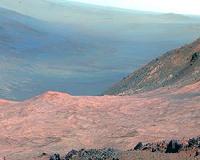
The rover is positioned on steep, north-facing slopes for improved solar array energy production. On Sol 4202 (Nov. 19. 2105), the robotic arm was raised so Panoramic Camera (Pancam) color images could be collected without an obstructed view of the foreground. On Sol 4206 (Nov. 23, 2015), a small bump of less than 3 feet (a meter) was performed to position some surface targets within the work volume of the robotic arm.
Additional Flash bank readouts were performed to support the Flash memory diagnostics. On subsequent sols, both Navigation Camera (Navcam) and Pancam imagery were collected. On Sol 4211 (Nov. 28, 2015), the robotic arm was used to collect a Microscopic Imager (MI) mosaic of the surface target, named 'Pvt. Hugh McNeal.' This was followed with the placing of the Alpha Particle X-ray Spectrometer (APXS) on the same for multi-sol integration.
As of Sol 4214 (Dec. 1, 2015), the solar array energy production was 387 watt-hours with an atmospheric opacity (Tau) of 0.544 and a solar array dust factor of 0.643.
Earlier Status Report
After several sols of operating using Flash storage, the rover switched to using just RAM during Sol 4194 (Nov. 10, 2015), in order to safely use the robotic arm. The Microscopic Imager (MI) collected a mosaic of the surface target, 'Pvt. Ebenezer Tuttle' which was followed by the placement of the Alpha Particle X-ray Spectrometer (APXS) for several sols on integration.
On Sol 4195 (Nov. 11, 2015), Opportunity switched back to using Flash memory in order to recover many important science data products still stored in the Flash memory. A reset of the vehicle occurred on Sol 4196 (Nov. 12, 2015), but was quickly recovered to master sequence control by the ground team.
On Sol 4200 (Nov. 17, 2015), the rover was configured back to using RAM only. A 43-foot (13-meter) drive to a new location with steeper north-facing slopes was performed on that sol.
As of Sol 4201 (Nov. 18, 2015), the solar array energy production was 376 watt-hours with an atmospheric opacity (Tau) of 0.494 and a solar array dust factor of 0.612.
Earlier Status Report
The rover has been switched to using Flash again. The plan for this week is to return some high-value science data products stored in Flash memory. On Sol 4188 (Nov. 4, 2015), an atmospheric argon measurement was collected using the Alpha Particle X-ray Spectrometer.
On Sol 4189 (Nov. 5, 2015), a problem with the Deep Space Network station transmitter prevented our sequence plan from being sent to the rover.
Independently on that sol, Opportunity experienced a reset, not unexpected since Flash memory was enabled. New sequences and a recovery plan were sent to the rover on Sol 4190 (Nov. 6, 2015). But a timing error prevented the master sequence from starting. A team came in over the weekend and built a real-time sequence activation command that was sent on Sol 4191 (Nov. 7, 2015), restoring the rover to master sequence operation.
As of Sol 4193 (Nov. 9, 2015), the solar array energy production was 359 watt-hours with an atmospheric opacity (Tau) of 0.511 and a solar array dust factor of 0.609.
