
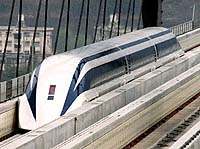
Shanghai's high-speed magnetic levitation train line was operating normally Monday, its operator said, days after a fatal crash in Germany raised concerns about the ultra-modern technology. "Everything is in normal operation, and there is no special examination being carried out," said Chen Sheng, an official with the passenger service center of the Shanghai Maglev company.
China currently operates the world's only commercial application of the revolutionary technology, a line running 30 kilometers (19 miles) from Shanghai's airport to the financial centre in Pudong district.
After Friday's crash that killed 23 people in Germany, investigators there are looking into safety procedures and their implementation, which has raised questions about the future use of the expensive technology.
The test train was traveling at about 170 kilometers (105 miles) an hour on an elevated concrete monorail test track in Lathen, in Germany's northwest, when it collided with a maintenance vehicle.
Initial investigations have appeared to point to human error rather than engineering problems.
But if the technology was found to be flawed, it could have devastating consequences for Transrapid International, the consortium between German industrial giants ThyssenKrupp AG and Siemens behind the venture.
China has been eager to expand its current Shanghai train line about 170 kilometers (105 miles) to the neighboring city of Hangzhou and, according to German newspaper Die Welt, a Chinese delegation was due in Germany next week.
But discussions have not gone well, with German officials rejecting Chinese demands for access to sensitive technology on the train that can reach speeds of 430 kilometers an hour, press reports have said previously.
China is seeking to build the new train line with much less input from Transrapid, after having relied on the consortium very heavily for the original Shanghai venture.
Source: Agence France-Presse
