
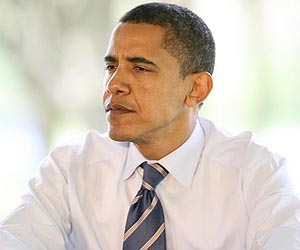
The US-South Korean alliance is "stronger than ever," President Barack Obama said Saturday in the wake a deadly North Korean assault on its southern neighbor.
"At a time in which there are increasing tensions on the Korean peninsula following the North's unprovoked attack on the South Korean people, today we are showing that the defense alliance and partnership of the United States and South Korea is stronger than ever," Obama said.
His remarks were part of a statement welcoming a landmark US-South Korea free trade agreement reached after three years of deadlock.
Incoming South Korean Defense Minister Kim Kwan-Jin said earlier that Seoul would "swiftly and strongly respond with force" until North Korea surrenders if the communist state launches another assault.
In his inauguration speech after President Lee Myung-Bak officially appointed the retired four-star general as the new defence chief, Kim said the sinking of a South Korean warship in the Yellow Sea in March and the shelling on Yeonpyeong island left "indelible wounds" on the South's pride and honor.
Earlier this week, South Korea's military announced just days after it wrapped Yellow Sea maneuvers with the US navy that it was planning more joint naval drills with the United States this month.
earlier related report
Three-nation talks to take up N.Korea nuclear issue
Tokyo (AFP) Dec 3, 2010 –
The United States, Japan and South Korea will discuss North Korea's uranium enrichment and other developments related to its nuclear ambitions in Washington next week, Japan's top diplomat said Friday.
Japanese Foreign Minister Seiji Maehara said he plans to discuss with his US and South Korean counterparts "what kind of factors should be incorporated" into the premise of holding multilateral talks proposed by China.
Maehara will meet with US Secretary of State Hillary Clinton and South Korea's Kim Sung-hwan some two weeks after Pyongyang killed four South Koreans in its first shelling of a civilian area in decades.
Following North Korea's deadly artillery attack and its recent boasting about a new uranium reprocessing plant, China, under pressure to bring its ally to heel, proposed multilateral talks in Beijing in early December.
But Washington, Tokyo and Seoul have snubbed Beijing's proposal for six-way crisis talks that would also include Moscow and Pyongyang — instead scheduling their own three-way foreign ministers' talks in Washington next Monday.
"The issue of uranium enrichment had not been discussed in the six-party talks, but that of course should be discussed at the forum," Maehara told reporters. "The uranium enrichment issue should never be let go."
"This I think will be easily agreed between Japan, the United States and South Korea," he said.
He also hopes to discuss in Washington his idea that North Korea should accept inspectors from the UN nuclear watchdog the International Atomic Energy Agency (IAEA) after it showed off a a new uranium reprocessing plant to a US scientist, he said.
"I hope we will respond to China with a counter-proposal" after the meeting in Washington, Maehara said.
"We didn't simply reject the Chinese proposal (of holding a six-party meeting). We say just meeting, without prospects of any progress, is unacceptable," Maehara said.
In November a US scientist revealed he had been shown a new uranium enrichment plant equipped with at least 1,000 centrifuges at the North Korea's Yongbyon nuclear complex outside the capital Pyongyang.
North Korea abandoned six-party talks on ending its nuclear drive in April 2009 after launching a long-range rocket — a move that earned UN condemnation and a new round of punitive sanctions.
Share This Article With Planet Earth
