
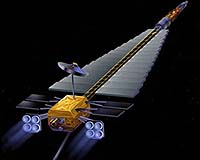
Designing complex systems such as nuclear reactors for space applications can be a daunting task, but researchers at Oak Ridge National Laboratory seem to have made it less intimidating by borrowing from nature.
Using a mathematical formula called a genetic algorithm optimization tool – which is derived from the natural selection process – the researchers said they have quickly performed searches of huge numbers of potential solutions to an engineering problem and identify the best options.
Advances in supercomputing and advanced optimization technologies are making it possible to sift through an enormous number of possibilities, even for complex problems such as spacecraft nuclear reactor design.
"Designing space reactor power systems, nuclear reactors or safer automobiles is a long process that involves making perhaps thousands of choices," said lead researcher Louis Qualls, a nuclear systems integration specialist. "It can take months or years to perform all of the necessary calculations using traditional methods."
By using genetic algorithms, Qualls said, "we can perform those calculations and end up with a short list of potential solutions in a matter of just minutes or days, depending on the problem."
As in nature, genetic algorithms have evolved by removing poor solutions or designs that do not perform well, and repopulating the next generation of computations only with combinations – or mutations – of better designs. Over time and with successive generations only the best options remain.
Unlike traditional design analyses, which are limited to the specific input of engineers, complete with their biases, genetic algorithms show great promise for improving designs with virtually no boundaries. The technique reaches each solution without sequential design information, the researchers said, resulting in novel approaches that would likely never be generated with conventional methods.
Qualls illustrated the advantage of genetic algorithm-based design methods with a recent example proposed by the laboratory's Nuclear Science and Technology Division irradiation engineering team. Their challenge was to optimize the design of an experiment in which 128 material test specimens were to be irradiated in ORNL's High Flux Isotope Reactor.
The specimens were composed of four different materials that were to be distributed over three different temperatures to obtain the broadest range of evenly spaced irradiation damage levels.
"There are literally billions and billions of possible combinations of temperature and specimen arrangements," he said. "While this is something that can be solved manually given some time, it makes a lot of sense to use genetic algorithms to quickly find the most promising solutions. In just a few minutes, we found four solutions that were marginally better than the manually derived solutions."
Other possible applications for the algorithms include materials research and development, and understanding how various metals and alloys respond to extreme radiation.
Qualls said ORNL has established a long tradition of excellence in these areas and continues to play a key role in the nation's efforts to develop nuclear reactors for the space program and commercial nuclear power.
The Department of Energy's Office of Science funded the research through its Laboratory Directed Research and Development program. NASA also provided funding.
