
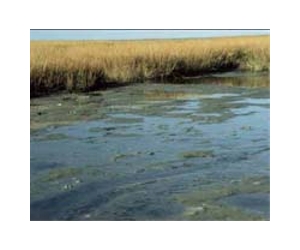
A small Norwegian company said Tuesday it had developed a peat moss mixture that could protect parts of the US coast from giant plumes of oil gushing from the wreckage of the BP-leased Deepwater Horizon platform in the Gulf of Mexico.
The company, Kallak Torvstroefabrikk, says one kilo (2.2 pounds) of its peat moss can absorb the equivalent of five times its weight in oil.
"This makes it possible to protect fragile stretches of the coast: a beach, a swamp, a nesting ground for birds," said Ragnar Kallak, who heads up the three-man company some 70 kilometres (43 miles) southeast of Oslo.
When placed near the shore, the peat moss, which is made up of decomposed vegetation, absorbs oil but not water, thus blocking the black liquid from polluting the coast, he told AFP.
The peat moss can also be used to clean beaches and rocks already hit by an oil slick, he explained.
"It's high-tech nature," Kallak said.
According to Norwegian scientific and industrial research group Sintef, the absorption method worked well when it was tested in 2009 after the Full City tanker ran aground off Norway's southeastern coast.
Kallak said he had been contacted by a fungi specialist from New Orleans, David Jonsson, who said he had been approached by the US Environmental Protection Agency, which was interested in looking into the peat moss clean-up method.
BP has estimated that about 5,000 barrels, or 800,000 litres, have been spewing each day since April 22 from the ruptured oil line in the Gulf of Mexico.
Some experts have however cautioned that BP is vastly underestimating the amount of oil actually spilling into the Gulf, saying the true amount may be 10 times as much.
"We cannot yet treat an entire oil slick just with peat moss, but it is a supplement that makes it possible to protect some high-priority areas," Kallak said.
earlier related report
Underwater oil plumes could create new 'dead zone' in Gulf
New Orleans, Louisiana (AFP) May 17, 2010 –
Giant plumes of oil drifting deep in the Gulf of Mexico could create a new 'dead zone' of oxygen-depleted waters unfit for marine life and wreak environmental damage that will take generations to overcome, scientists warned Monday.
"Normally, in a shallow spill, everything pretty much shoots up to the surface and the impacts are primarily to surface organisms like turtles, dolphins, and birds," said Paul Montagna, a marine ecologist at the Harte Research Institute for Gulf of Mexico Studies.
But the oil which has been gushing out of the wreckage of the BP-leased Deepwater Horizon since April 22 is traveling up through chilly, dark waters 5,000 feet below the surface.
"Under this really cold, high pressure environment the oil is getting dispersed through the water column," Montagna said in a telephone interview.
"What that means is that basically life in the entire water column is now being exposed."
Adding to the toxic soup are more than 580,000 gallons of chemical dispersants applied to the surface of the slick and also directly into the subsea stream of crude gushing out of a ruptured pipe.
Those dispersants are being used to help keep the oil away from sensitive shorelines by breaking it up into smaller clumps, some of which will be consumed by microbes and some of which will eventually sink to the ocean floor.
The problem is that those microbes end up consuming oxygen in the process and there is an enormous amount of oil that needs to be consumed, said Chris D'Elia, dean of the School of Coast & Environment at Louisiana State University.
"The toxicity alone or the bod (the biological oxygen demand) problem alone are substantial issues," D'Elia told AFP.
"When you start adding the two together, God only knows what's going on."
The Gulf already suffers from a massive 'dead zone' which forms every spring when agricultural runoff carried out to sea by the Mississippi River causes algae to bloom and suck up the oxygen in shallower waters.
Mobile marine life like fish, shrimp and dolphins usually migrate east of the dead zone, which happens to be the area most directly affected by the oil slick.
"Clearly you'd expect a huge die off in the water column as well as in the (affected) sediments," said Wilma Subra, a chemist and consultant who works with the Louisiana Environmental Action Network.
Another major concern is that the subsea oil and dispersants can be carried by currents in an entirely different direction that where the wind and waves send the surface slick, creating a "much larger area of impact," Subra said.
BP has managed to stem the flow of oil by about 1,000 barrels a day using a mile-long tube inserted into the mouth of the ruptured pipe which is funneling the crude up to a waiting ship.
BP estimates that about 5,000 barrels of oil a day are currently gushing out of the pipe, but independent experts have said that the amount could be as much as ten times higher.
"Even when the leak is stopped completely, there's still going to be that large sheen, there's still going to be that large (level of) dispersant in the water column and in the sediment," Subra told AFP.
"The environmental impact will go on from those sources for a very, very long time and the results of those impacts will last for generations."
Researchers with the National Institute for Undersea Science and Technology discovered evidence of huge undersea plumes of oil – one reportedly 15 to 20 miles long and four or five miles wide – which were already beginning to deplete the oxygen in nearby water by as much as 30 percent.
The discovery of the plumes prompted sharp calls from Washington for BP to provide a better estimate and analysis of the amount of oil gushing out of the wreckage of the Deepwater Horizon.
"BP is burying its head in the sand on these underwater threats," Representative Edward Markey, chair of the House subcommittee on energy and the environment, said in a statement Monday.
"These huge plumes of oil are like hidden mushroom clouds that indicate a larger spill than originally thought and portend more dangerous long-term fallout for the Gulf of Mexico's wildlife and economy."
Jane Lubchenco, who heads the National Oceanic and Atmospheric Administration, cautioned that it was "premature" to conclude that the plumes were caused by the use of chemical dispersants.
"As we have emphasized, dispersants are not a silver bullet," she said in a statement.
"They are used to move us towards the lesser of two environmental outcomes. Until the flow of oil is stemmed, we must take every responsible action to reduce the impact of the oil."
Share This Article With Planet Earth
