
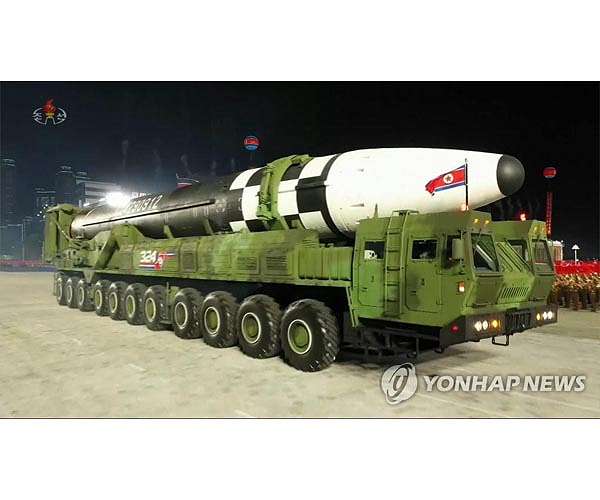
For months, boffins have speculated on a new Intercontinental Ballistic Missile (ICBM) being developed by North Korea. Official statements by North Korea have regularly hinted at the development of this new weapon, but outside observers had little more than rhetoric to ponder.
There were no tests of this missile, no photos, and no precise technical statements. Some analysts could be forgiven for wondering if all the talk was nothing more than bluster, designed to make North Korea seem more dangerous during critical times in its dealings with the world. Now, we have more material to digest, but not a full-course meal. We can still speculate if North Korea's new ICBM truly represents a strategic threat, even if North Korea plans this.
North Korea's new ICBM has been unveiled to public scrutiny at a military parade, celebrating the 75th anniversary of the founding of the Workers' Party of Korea. Such parades are typically used to showcase new weapons. Media access to this event was strictly controlled, and even the timing of the event in dark hours was unusual. Travel restrictions designed to limit the spread of the COVID-19 coronavirus can partially explain some of these changes, but not all.
Parading in the dark was presumably designed to spoil attempts to observe the parade with satellites. This could have been partially successful for some of the numerous eyes in the sky that monitor this nation, but it would not have been totally effective. In any case, official North Korean images and video provide some curious clues to this new weapon.
Rewind back to 2019, when speculation about this new missile was high. Government statements about a new weapon were given credibility by the testing of engines at a ground test stand, which was later dismantled. North Korea staged a Grinch exercise for some analysts (including this author), partially distracting us from Christmas festivities with the threat of a "Christmas gift" that wouldn't exactly reflect the spirit of goodwill of the times.
The possibility of an ICBM test on Christmas Day was realistic, given the sour mood of negotiations with the USA. It's also worth remembering that North Korea once staged a large rocket launch on July 4, Independence Day for the USA. Spoiling festivities already had a precedent. Staging a missile launch at this time would also remind the world of North Korea's self-imposed deadline of December 31, 2019, when its patience with US-North Korean diplomacy would allegedly run out.
The new missile has been rolled out on a typical sort of Transporter-Erector-Launcher, and is clearly a derivative of the recent family of Hwasong long-range missiles. The first stage of this missile looks suspiciously like the first stage of the Hwasong-15 ICBM, which is capable of reaching the continental USA. But things atop this first stage are different. There's clearly a larger second stage, and a fairing that is different from Hwasong-15 missiles.
It's reasonable to assume that the second stage uses a new engine that made its debut at the aforementioned test site. But the fairing is curious. There's clearly room for a lot more inside than we had on a Hwasong-15. It could be speculated that the fairing conceals decoys or some form of additional propulsion stage, designed to give the warhead extra range. Some analysts have wondered if North Korea is preparing to install multiple warheads on a single missile. For the moment, this analyst will take a conservative approach and suggest otherwise.
This analyst will also suggest that there are no changes to the nuclear package designed to be carried on the missile, but external observations give no clues to this. It's simply the case that North Korea seems to have produced a reliable design for its nuclear and thermonuclear weapons, and has performed no further testing in recent times.
The strategic goal of this missile is easy to guess. While earlier North Korean ICBMs are judged to be capable of reaching the US mainland, there are still doubts about their ability to cover the entire nation. It seems plausible that targets on the West coast are in range for these weapons, but possibly not the East coast. The new missile is presumably designed to be capable of reaching Washington D.C. as well as Washington state.
It all looks impressive, but does it really work? Not even the North Koreans know. This new missile has never been tested, and apart from ground engine tests, not even the second stage has flown. But its colours also give clues to the development of the weapon. Unlike the drab paint job of the first stage, the second stage is painted with a chessboard grid of black and white squares. This is clearly an optical pattern, designed to make rolls and other motions of the missile easier to observe during test launches. Similar designs have been used throughout the history of rocketry. The paint schemes give further support to the design heritage of the new missile. A (possibly) unmodified Hwasong-15 first stage has been topped with new kit.
Presumably, the missile we saw on parade is an actual test article, designed to be launched at some future date. But why didn't we get a Christmas launch, as previously threatened? One cause could be political. Back-channel negotiations or internal politics could have stopped such a launch. But it's also possible that the missile simply wasn't ready for an actual test launch. We can't even be sure if it is fit to fly right now.
It's easy to drive the weapon through Pyongyang as an exhibit, but this gives no clues to its level of perfection. When (or if) the new missile is actually launched is difficult to predict. It will be determined by a mixture of internal politics, external relations and technical factors. Right now, we live in uncertain times, and those uncertainties will make it difficult to predict the future of this new missile.
