
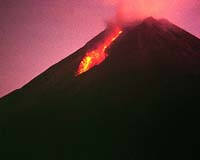
A fresh lava dome at the peak of Indonesia's trembling Mount Merapi continued to expand Wednesday, suggesting an eruption that would send heatclouds down its slopes, a scientist warned Wednesday.
The new dome formed by lava outflow at the top of the mountain has been steadily expanding for more than a week, said Muzani from the vulcanology office in Yogyakarta, 30 kilometers (18 miles) south of the volcano.
Muzani said that the frequency of the volcano's multi-phased earthquakes, which signal high magma activity inside the mountain, has been fluctuating but they were still within a high range.
On Tuesday alone, 156 multi-phased earthquakes were recorded inside the volcano while for the first six hours of Wednesday alone, 44 were noted.
Mas Ace Purbawinata, a geologist at the vulcanology office headquarters in Bandung, West Java, said that the high frequency of quakes signalled that magma inside the mountain continued to exert a high pressure on its clogged crater.
"Reports I have been given show that this new lava domes continues to grow, and when it has reached an unstable form, it may collapse and results in an outflow of both pyroclastic flows, more popularly known as heatclouds, and magma," Purbawinata said.
"It will not have an explosive eruption but it will be more in the form of a lava outflow, and more dangerously accompanied by the swift descent of heat clouds," Purbawinata warned.
Merapi remains on a standby alert status, one step below an alert which would require the mandatory evacuation of more than 29,000 people living nearby.
In its last large eruption in 1994, heat clouds known locally as "shaggy goats" careened down the volcano at more than 100 kilometres (62 miles) per hour, reached temperatures of 600 degrees Celsius.
The clouds killed some 66 people on the southern slopes of the mountain.
Hundreds of residents have already been relocated to temporary shelters but many living on the volcano's slopes have refused to leave.
Typically, Merapi has small eruptions every two to three years and larger ones every 10 to 15 years.
Indonesia sits on the Pacific "Ring of Fire" noted for its volcanic and seismic activity. The country has more than 100 active volcanoes.
Source: Agence France-Presse
