
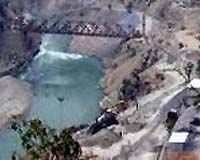
A World Bank-appointed expert said he would begin inspecting Sunday a controversial dam being built by India in the disputed region of Kashmir.
Pakistan fears the one-billion-dollar Baglihar project could deprive its wheat-bowl state of Punjab of vital irrigation water. It says the plant violates a 45-year-old water-sharing treaty brokered by the World Bank.
The World Bank appointed the Swiss professor as a neutral expert to address differences between India and Pakistan over the dam being built in southern Indian Kashmir after the countries could not resolve the issue.
"We're going to visit the site just to try to understand," Raymond Lafitte, a civil engineer, told reporters Saturday in Jammu, winter capital of Indian Kashmir.
He declined further comment, saying he had a "duty to report to the governments of India and Pakistan first," but promised his work would be "totally transparent."
He did not say when the report would be presented to the two governments.
Lafitte, a professor at the Swiss Federal Institute of Technology, said he would spend three to four days at the dam site on the Chenab River in south Kashmir.
He was being accompanied by Indian and Pakistan government technical teams.
Indian officials say the 450-megawatt Baglihar project does not contravene the pact and could go a long way to ending routine 12-hour blackouts plaguing the Himalayan state.
Kashmir Chief Minister Mohammed Sayeed said neutral experts were "welcome to inspect" the dam, saying it in no way breaches the water-sharing treaty.
The row over the dam has been an irritant in the ongoing peace process between the South Asian nuclear rivals, who have fought three wars, two of them over Kashmir. Both hold the region in part but claim it in full.
The World Bank treaty divided the river systems between the two countries and has survived the 1965 and 1971 wars between the two South Asian neighbours.
Under the terms of the 1960 treaty, Lafitte's decision will be final and binding, the World Bank has said.
