
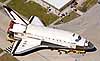
John Glenn isn't the only astronaut whose extraterrestrial activities could end up enhancing the quality of life for older adults. Penn State's Dr. Jim Pawelczyk, assistant professor of kinesiology and physiology, and his space-going colleagues scheduled to be aboard the Neurolab mission in April will conduct more than two dozen studies that hold promise for older adults and others.
Pawelczyk, who is the first Penn State faculty member chosen for
Shuttle duty, will be conducting some of the space-based
experiments on himself. But his youth won't mean the results are
only applicable to young people.
"Many of the changes we see in space flight are similar to those
associated with the aging process," says Pawelczyk, a faculty
member in the College of Health and Human Development. "These
include a loss of blood volume and less precise control of the
cardiovascular system, changes in the vestibular system which
controls balance and, on longer flights, loss of muscle mass and
bone mineral. Mechanisms responsible for these adaptations may
help us to identify the causes of similar problems often seen in
the elderly."
As a payload specialist, Pawelczyk's chief duty aboard the 17-day
Shuttle Neurolab mission is to serve as both operator and subject
for the 26 studies scheduled for the mission. The studies were
proposed by teams of scientists from Japan, France, Germany,
Italy, and Canada, as well as the United States. Pawelczyk and the
other crew members will carry out their experiments for them.
The experiments are designed to determine how the brain and
nervous system adapt to the stresses of life in space. In a recent
visit to campus, Pawelczyk described one experiment that will be
duplicated on Earth by elementary school children who follow the
in-school WPSX-TV program, "What's In The News." The experiment
involves catching a ball.
Pawelczyk explained that when we catch a ball on Earth, we are
drawing on our understanding of how objects accelerate in gravity.
Based on this understanding, we can successfully anticipate where
the ball will be and catch it.
"In space flight," Pawelczyk said, "the ball isn't going to
accelerate. It's going to be at a constant velocity. So, we're
going to have to relearn that simple motor task to successfully
catch the ball. This same learning process applies very much to
people who have to re-learn motor tasks as the result of stroke."
Another of his focuses on the Shuttle will be four experiments on
blood pressure regulation and orthostatic intolerance, an
inability to maintain consciousness that results from an
inadequate blood supply to the brain. A specialist in autonomic
neurophysiology, Pawelczyk is one of a team of co-investigators
with Dr. C. Gunnar Blomquist, University of Texas, Southwestern
Medical Center, on this study.
Researchers estimate that over a half million, mostly older,
Americans suffer from disorders involving orthostatic intolerance.
But young people can be affected as well.
"It happens after space flight in about two-thirds of astronaut
personnel and it then resolves itself," Pawelczyk says. "But
during that period of time, we have a window where, basically, we
have a relatively young healthy person looking like a much older
person in terms of orthostatic tolerance."
The Shuttle orthostatic intolerance experiments will investigate
the autonomic nervous system, which controls blood pressure
moment-to-moment. Pawelczyk will measure blood pressure, blood
flow to the brain and other cardiovascular parameters. In
addition, he will place a thin electrode, the size of an
acupuncture needle, in a nerve just below the knee of three crew
members to record the signals going from the brain to the blood
vessels. These signals cause blood vessels to constrict which
increases blood pressure just as stepping on a garden hose
increases water pressure, says Pawelczyk. Dr. Jay Buckey, the
other payload specialist on board the Neurolab mission, will
perform the procedure on Pawelczyk.
During his recent campus visit, Pawelczyk was asked whether his
experience aboard the Shuttle will be useful in his teaching when
he returns to University Park after the mission. Pawelczyk
replied, "I don't see any way around it."
In fact, while he's still aboard the Shuttle, Pawelczyk and Dr.
Peter Farrell, professor of physiology, will discuss the
experiments with Penn State students in a live
question-and-answer, distance education experience. Students at
three other universities will also talk to the other payload crew
members during the mission.
"Space flight is a good way to excite students about science and
research," Pawelczyk says. "It is still a new frontier."
Pawelczyk is scheduled to leap that frontier's boundaries on April
16 at 2:19 p.m. As the first Penn State faculty member to do so,
he promises to return a full measure of teaching, research and
service as did the original Land Grant university pioneers.
