
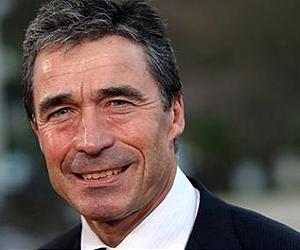
NATO Secretary General Anders Fogh Rasmussen on Monday urged the European Union to link huge swathes of its military operations to the transatlantic defence alliance.
Rasmussen wants to build "a true strategic partnership between NATO and the European Union," to maximise operational capabilities in Afghanistan or the fight against high-seas piracy at a time of massively stretched public budgets.
"NATO and the EU are two of the world's most important institutions," Rasmussen said at a policy conference hosted by the Security and Defence Agenda think-tank in Brussels.
"They share 21 members. They have complementary skills. And no other strategic partnership would offer so many benefits — both operationally and financially," he added.
"But it is in Afghanistan that improved institutional cooperation would bring the most significant operational benefits," he said, adding that it "would help to deliver the unity of effort that is required for success in Afghanistan."
A strategic partnership between NATO and the EU would also be a "major cost-saver" at a time when governments are under pressure to slash budget deficits, Rasmussen said.
NATO is likely to launch a new capabilities initiative to address what Rassmussen called critical shortfalls at its Lisbon summit in November.
"The EU shares many of these shortfalls, so what better way to proceed than by inviting EU nations to join this initiative," the NATO chief suggested.
Rasmussen recently urged a "paper tiger" Europe to ramp up investment in a costly missile defence umbrella, echoing predecessors' efforts down the years at key points in the development of all significant defence projects.
Wary of an economic straitjacket hitting defence spending, the Danish former prime minister has already urged allies to cut "fat not muscle".
According to NATO data, only five of the alliance's 28 member countries respected its minimum engagements to spend two percent of national output on defence in 2009: the United States, whose spending at 574 billion dollars easily dwarfed the others, along with Albania, Britain, France and Greece.
In a letter to Rasmussen at the end of April, nine member countries called for a restructuring of NATO that would affect everything from its headquarters to its command structure.
Share This Article With Planet Earth
