
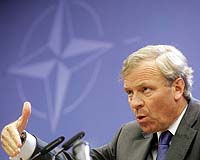
NATO Secretary General Jaap de Hoop Scheffer on Monday chaired an extraordinary meeting of alliance ambassadors aimed at finding more troops to combat the tenacious insurgency in southern Afghanistan. The meeting followed a call last week by NATO's military chief, US General James Jones, for reinforcements of up to 2,500 troops to deal with increasing attacks by the Taliban militia, ousted from power in 2001.
NATO's manning difficulties also come amid deep concern that nations which promised aid and donations in January to the conflict-torn country may be preparing to renege on their pledges.
A British expert warned Monday that failure is a stark possibility if additional troops are not found.
"There is a very, very big risk," Major Charles Heyman of The Armed Forces UK review said. "If the mission in southern Afghanistan doesn't get the right amount of troops devoted to it… it's possible that this mission will fail."
Alliance spokesman James Appathurai said the informal talks were to inform the 26 NATO allies about developments in Afghanistan and look at ways to generate troops, without making decisions on numbers or who might provide them.
They follow discussions between NATO defence chiefs in Warsaw last week and were held "with an eye to the troop generation meeting on Wednesday" at NATO's military headquarters in Mons, southern Belgium, he said.
According to a NATO diplomat, speaking on condition of anonymity, "General Jones spoke about reinforcements of some 2,000 troops" in his remarks to the ambassadors.
Another diplomat said they had understood "the general need for greater flexibility".
On Saturday, the chairman of NATO's military committee, Canadian General Ray Henault urged the allies to come good with reinforcements, saying: "We are currently at about 85 percent of the requirements and want the remainder."
NATO took control of military operations in southern Afghanistan on July 31 from a US-led coalition that has been fighting the Taliban and hunting Osama bin Laden and parts of his Al-Qaeda network.
The move was part of a four-phased plan to extend the reach of President Hamid Karzai's weak central government with the NATO-led International Security Assistance Force (ISAF) to all points of the compass.
But after relatively painless expansions into northern and western regions, the alliance has met surprisingly fierce resistance from the Taliban and its allies among the drug runners and warlords.
More than 90 foreign soldiers have died in combat this year, and casualties have been high among British and Canadian soldiers who, along with Dutch and Australian troops, form the backbone of the ISAF contingent in the south.
Jones said only "modest reinforcements" would be needed, and that it was more important for the troops to have the capacity to act in a robust manner.
But few nations appear ready to step forward and many claim they are either over-stretched or face major political or public opposition to putting their soldiers in harm's way.
In Canada, The Globe and Mail newspaper reported Monday that Ottowa is preparing to send 15 Leopard tanks and an additional 120 soldiers to bolster the NATO contingent in Afghanistan.
An armored unit has received orders to prepare for deployment to Afghanistan on September 17, it said.
Canada's defense ministry said it was looking at how Ottawa could strengthen the NATO mission.
"We're continually assessing our operations and we adjust them to ensure that the forces have the best people and equipment available," said Karen Johnstone, spokeswoman for the defense ministry.
NATO's need for troops, which could decline slightly in coming months as cold weather makes it difficult for insurgents to operate in the mountainous south, comes as reconstruction in Afghanistan starts to lag.
The security operation could face failure if development slows and the public loses interest in democracy and turns once again to the Taliban, which was ousted in late 2001 for harbouring Bin Laden and his network.
Source: Agence France-Presse
