
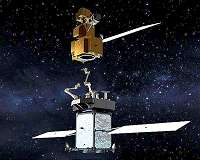
NASA has awarded the Restore-L Spacecraft Bus and Support Services contract to Space Systems/Loral of Palo Alto, California. Restore-L is a robotic spacecraft equipped with the tools, technologies and techniques needed to service satellites currently in orbit.
The contract has a firm-fixed-price and includes a three-year core period and a two-year indefinite-delivery/indefinite-quantity portion. The total maximum value of the contract is $127 million.
Space Systems/Loral will provide spacecraft bus, critical hardware and services for the development, deployment and operations of the Restore-L mission. They also will provide related services to accomplish mission integration, test, launch and operations.
The Restore-L Project is managed within NASA's Satellite Servicing Projects Division at the agency's Goddard Space Flight Center in Greenbelt, Maryland, for NASA's Space Technology Mission Directorate.
The Satellite Servicing Projects Division at Goddard was established in 2009 to continue NASA's 40-year legacy of satellite servicing and repair. Restore-L is a free-flying mission projected to launch in 2020 to perform in-orbit satellite servicing on an operational government asset in low-Earth orbit.
–SPACE STORY-
farm
hg
259
23-DEC-49
Neolithic Syrians were first to domesticate cereals
Neolithic Syrians were first to domesticate cereals
neolithic-syrians-first-domesticate-cereal-barley-wheat-hg.jpg
neolithic-syrians-first-domesticate-cereal-barley-wheat-lg.jpg
neolithic-syrians-first-domesticate-cereal-barley-wheat-bg.jpg
neolithic-syrians-first-domesticate-cereal-barley-wheat-sm.jpg
11,000 years ago, a Syrian community began a practice which would change man's relationship with his surroundings forever: the initiation of cereal domestication and, with it, the commencement of agriculture, a process which lasted several millennia. Image courtesy CSIC Communications. Watch a video on the research here.
Spanish National Research Council
by Staff Writers
Madrid, Spain (SPX) Dec 06, 2016
11,000 years ago, a Syrian community began a practice which would change man's relationship with his surroundings forever: the initiation of cereal domestication and, with it, the commencement of agriculture, a process which lasted several millennia. The discoveries, made at the Tell Qarassa North archaeological site, situated near the city of Sweida in Syria, are the oldest evidence of the domestication of three species of cereal: one of barley and two of wheat (spelt and farrow).
The team from the Spanish National Research Council (CSIC) and the Universities of Cantabria and the Basque Country (both in northern Spain) was led by CSIC's Juan Jose Ibanez, and excavated in the area between 2009 and 2010. Scientific investigators from the Universities of Copenhagen and London also collaborated in the study which is published in the latest edition of the magazine Proceedings of the National Academy of Sciences (PNAS).
The Neolithic man in question lived at a time of huge changes. They gathered wild wheat and barley and gradually began the process of domesticating them. That is to say, they began to build a local economy based around controlling the reproduction of the foods they ate.
The origins of agriculture
Although it was already known that cereal breeding took place in the Near East, it was not known whether the first domesticated cereals appeared in one region or in several regions simultaneously, or, if the first case were true, in which region.
"The process began when hunter gatherer communities started collecting wild cereals, leading in turn to these wild cereals being sown, then reaped using sickles. This initial crop husbandry led to the selective breeding of cereal grains. Gradually, domestic traits became more and more dominant", explains Ibanez.
To be precise, it is this work at Tell Qarrassa which allows samples of cereals from the very first phase in the domestication process to be identified. Of all the cereals which were grown at the site, around 30% show domestic traits whilst the remainder continue to show traits which are characteristic of wild cereals.
"We now know that the cereals from Tell Qarassa were sown in autumn and harvested in February and March, before reaching full maturity to prevent the risk- given that they were still partially wild- of heads breaking off and being lost at harvest.
The crop was cut close to the ground so as to make full use of the straw and, once collected, it would be thrashed and the grain cleaned in the courtyards outside their homes before being stored inside. Prior to being eaten, the grain was crushed in a mortar and pestle then ground in hand mills", explains the CSIC investigator.
The information obtained at Tell Qarassa shows both the advanced level of technical development of these first farming communities and also that the domestication process of cereals unfolded at varying rates in the different regions of the Near East.
"It has yet to be discovered whether the later appearance of domesticated cereals in these regions was due to the use of those cereals originating in the south of Syria which we have been studying, or whether other independent domestication processes took place elsewhere", concludes Ibanez.
