
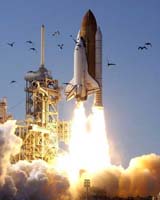
A close encounter of the "bird" kind during last year's return-to-flight launch of space shuttle Discovery prompted officials at NASA's Kennedy Space Center to look at ways to reduce the possibility of future occurrences.
During Discovery's launch, a large vulture struck the top of the external tank during ascent. Now KSC personnel are taking precautions to avoid another encounter with a large bird.
Officials formed a working group to discuss reducing the risk and to create a "Bird Abatement Plan." The effort has involved several contractor organizations, including Space Gateway Support, Yang Enterprises, InDyne Inc., United Space Alliance, ASRC Aerospace, Dynamac Corp., and the U.S. Fish and Wildlife Service at the nearby Merritt Island National Wildlife Refuge.
Even a veterinary pathologist from Disney's Animal Kingdom in Florida, which operates a bird-control program, was invited to the center to share wildlife management expertise. Part of the plan involves determining ways to reduce the vulture population at the space center.
"First we wanted to look at the root of the problem, which is the food source, and create an awareness program to help remove that source," said Steve Payne, with NASA's Shuttle Processing directorate.
With that goal in mind, KSC began a "Roadkill Roundup" program, led by Space Gateway Support, last April. It encouraged personnel to report the location of dead animals on or near the side of space center roads so workers can remove roadkill.
Yang Enterprises entomologist Glenn Willis said more than 100 animals have been removed so far, including raccoons, possums, armadillos, hogs, turtles, otters and even a few alligators.
"The center, located on 160,000 acres of wildlife refuge, is a steward of this environment and there exists a unique balance between launches and preservation of the wildlife," Willis said.
Many organizations and contractors are participating in the efforts to deter the vultures and avoid collisions with them during liftoff.
Measures being taken include collecting data such as roadkill locations to determine where "Wildlife Crossing" signs should be installed, testing a catch-and-release enclosure, trying various sounds to startle or scare large birds away from the launch pads, and developing software for bird tracking based on camera images.
Officials also have placed remote cameras around the launch pads to track the vultures, and they are testing a radar system to detect bird activity around the pads before liftoff.
"Camera images and radar would allow us to look before we launch. We don't want the vehicle to get damaged in any way," Payne said, "and while this program does have some 'chuckle factor' to it, we do take it seriously."
