
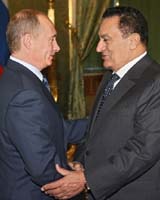
Egyptian President Hosni Mubarak met his Russian counterpart Vladimir Putin here on Thursday for talks on the Middle East conflict and reviving Egypt's nuclear energy programme. "We confirmed our intention to strengthen further relations in the economic and trade spheres, in the fields of peaceful nuclear energy, space, computers and hi-tech," Mubarak said after meeting Putin in the Kremlin.
Russian officials signalled that Mubarak's plans to resume Egypt's nuclear programme after a 20-year freeze was a key topic on the agenda for the Egyptian president's three-day visit.
"Egypt has made a decision to transfer to nuclear energy and build four stations," Boris Alyoshin, head of Russia's federal industry agency, told reporters on the sidelines of the Kremlin meeting.
"It is beyond doubt that we will take part in the tender and I think we have good chances of winning," Alyoshin said. Egyptian media said Mubarak was travelling to Russia and China to build nuclear energy links.
In his remarks, Putin referred to Cairo as a key regional partner for Moscow and said Egypt could play "a vital role in establishing contacts between Palestine and Israel and in bringing much-needed accord to Palestinian ranks."
Russia, part of the diplomatic "quartet" charged with settling the Middle East conflict along with the European Union, the United Nations and the United States, is strengthening its diplomatic and commercial role in the region.
Egypt initiated a nuclear energy programme in the 1970s but abandoned it in 1986 after the Chernobyl nuclear catastrophe. Mubarak has outlined plans to revive it.
Mubarak was also set to meet the directors of energy giants Gazprom, Lukoil and UES, as well as of car maker Avtovaz, jetmaker MiG and arms exporter Rosoboronexport during his visit, the Vremya Novostei daily said.
Analysts said the visit could rile the United States because of the nuclear energy talks and Egypt's apparent willingness to buy weapons from Russia rather than its traditional US suppliers.
"The arms market is extremely politicised. It is very important who you buy from," said Ruslan Pukhov, an arms specialist at the Centre for Analysis of Strategies and Technologies in Moscow.
Pukhov said Mubarak's visit might produce a deal on the purchase of MiG fighter jets. The Egyptian army already has large amounts of weaponry dating back to the Soviet era.
Ahead of his visit, Mubarak, who undertook military studies in Moscow in the 1960s, praised Russia's anti-aircraft systems and fighter jets as "the best in the world" in an interview with Vremya Novostei.
The trade turnover between Russia and Egypt amounted to 1.6 billion dollars (1.25 billion euros) in 2005 and grew by 52 percent in the first eight months of this year, the Kremlin official said.
In another interview, with the official Rossiiskaya Gazeta newspaper, Mubarak said he and Putin, both presidents with strong leadership styles, would see eye-to-eye on politics.
"There is no universal democratic model, since each people can implement the democracy that corresponds to the nature of that people, its culture, its characteristics and its customs," Mubarak said.
"I was very pleased when President Putin talked about Russia's democracy a few months ago. I am sure that Putin wanted to say the same thing," Mubarak added.
Source: Agence France-Presse
