
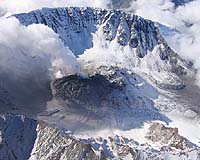
When Mount St. Helens erupted in 1980, it destroyed every living thing around it — and now scientists say a small insect is slowing the recovery process.
The eruption sterilized a 35-mile square area, but within a year plant life started to return. However, events are occurring differently from what ecologists anticipated.
"Typically ecologists have thought of the plant recovery process as interactions just between plants," said William Fagan, a University of Maryland theoretical ecologist and lead author of the study. He said primary succession studies have de-emphasized the importance of insects for the spatial spread of plants. But scientists have found insects — specifically caterpillars — are having a major impact on plant recovery at Mount St. Helens — an impact apparently slowing the rate of the spread of plant recovery.
"This is an example of ecological interactions that runs counter to conventional wisdom," added Fagan. The paper suggests it is an example that could help scientists better understand the dynamics of species recovery at Mount St. Helens and, in other contexts, the place of biological control agents in limiting the spatial spread of pest species.
The study will appear in the December issue of The American Naturalist.
