
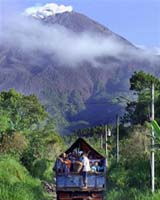
More people have fled the slopes of Indonesia's simmering Mount Merapi, unsure whether the volcano is set to erupt because of thick cloud blanketing its peak, officials said Sunday.
Scientists said that while the lava dome on top of the mountain was growing at a slower rate, the volcano still posed a risk to those living in its shadow.
Heavy rains over the past two days could also flush more lava down the slopes of the mountain, they said.
The volcano saw scores of lava flows and four bursts of heat clouds in the first six hours of Sunday, said Tri Yani, an official at the vulcanology office in Yogyakarta, some 30 kilometers (18 miles) south of the volcano.
She said the volcano was also spewing fumes up to 1.2 kilometers high.
The heat clouds, which geologists have warned was the primary threat posed by the volcano, travelled as far as 2.5 kilometers down the slopes, the official said. The nearest village is at least six kilometers from the peak.
The vulcanology office's chief analyst, Soebandriyo, said Saturday that although the magma supply that forms the dome at the peak appeared to be weakening, the magma structure may collapse and spew out millions of cubic metres (feet) of volcanic rock and lava.
But with thick cloud shrouding the mountain since Friday and preventing any visual warnings of descending lava or heat clouds, both of which incinerate everything in their path, more residents have fled their homes near the volcano to seek safety at emergency shelters.
A report from disaster coordination centers in the four districts deemed to be at immediate risk showed the number of evacuees at shelters around the mountain had increased by some 2,000 to around 22,000.
"Perhaps it has to do with the rains and because people are now unable to see whether Merapi is sending heat clouds or lava their way as the mountain is shrouded by clouds," said Puryono, an official of the Central Java disaster handling coordination center in Magelang.
Merapi's deadliest eruption occurred in 1930 when more than 1,300 people were killed. Some 66 people were killed when it last erupted in 1994.
