
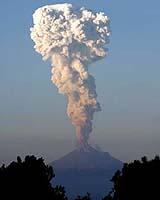
Seismic tremors were recorded on the Comoro Islands for the second consecutive day Sunday following a volcanic eruption on Mount Karthala, residents and officials said. The latest tremors were felt overnight and in the morning, but there were no reports of casualties or damage on Grande Comore, the main island in the Indian Ocean archipelago.
Locals living in Mboude, around eight kilometers (five miles) south of the capital Moroni, told AFP that they had fled their houses overnight and sought refuge in nearby villages.
Hamid Soule, head of the Karthala observatory, told reporters that the magnitude of the tremors had varied but that "the strongest measured at least five on the Richter scale".
The government put the islands' residents on red alert on Saturday after the first eruptions within the crater of the volcano, priming the police and army to safeguard the population and property.
There have been a number of scares in recent years after activity within the volcano, which is on the largest of the three islands that make up the Union of the Comoros. A fourth island, Mayotte, is under French rule.
In November 2005, Karthala spewed out huge plumes of ash that blanketed Grande Comore and temporarily deprived its 250,000 inhabitants of drinkable water.
In April 2005, nearly 10,000 villagers living at the base of the mountain fled their homes after similar emissions of ash started widespread fears of drinking-water contamination.
Mount Karthala last had an overflow magma eruption in 1977, when lava destroyed the village of Singani, some 20 kilometres south of Moroni, and toxic gas was released into the air but did not cause any deaths.
earlier related report
Red alert after Comoros volcano triggers tremors
Moroni (AFP) Jan 13 – Authorities in the Comoros Islands placed the population of the tiny Indian Ocean nation on red alert Saturday following several seismic tremors triggered by a volcanic eruption on Mount Karthala.
There were no immediate reports of damage and the government held back from ordering residents to evacuate their homes as a red glow could be seen over the top of the volcano, just 15 kilometers (nine miles) from the capital Moroni.
Hamid Soule, head of the Karthala observatory, told reporters that the eruptions had begun overnight.
The tremors had been a result of "internal (magma) activity which has given us cause for concern," he told a press conference.
While the lava which was produced overnight had now probably solidified, he added that "the internal activity is continuing".
"We cannot rule out the danger of a lateral eruption outside of the crater," said Soule.
A statement from the president's office confirmed that "a red alert status has been declared and emergency measures to ensure the security of people and property have been activated."
The armed forces and police had been primed to prepare for any eventuality, Colonel Ismael Mogne Daho, a senior official at the archipelago's emergency operation centre, told AFP.
There have been a number of scares in recent years after activity within the volcano.
In November 2005, Karthala spewed huge plumes of ash that blanketed the island and temporarily deprived its 250,000 inhabitants of drinkable water.
In April 2005, nearly 10,000 villagers living at the base of the mountain fled their homes after similar emissions of ash started widespread fears of drinking-water contamination.
Mount Karthala last had an overflow magma eruption in 1977, when lava destroyed the village of Singani, some 20 kilometres south of Moroni, and toxic gas was released into the air but did not cause any deaths.
Source: Agence France-Presse
