
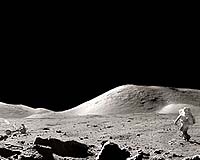
U.S. scientists determined that they can predict concentrations of certain minerals on the moon by comparing variations in reflected light. Samples of lunar rocks returned by U.S. astronauts show large variations in titanium oxide concentrations, suggesting complex compositional zonation within the lunar mantle.
M.S. Robinson of Arizona State University and colleagues, noting ilminite has very low reflective properties, used images of the moon's surface taken by the Hubble Space Telescope to determine where ilminite is present by comparing variations in the reflectance of ultraviolet and visible light.
They found areas of high and low ilminite abundance match well with expected values, based on rocks collected by astronauts of the Apollo missions but the ilminite abundances do not give insight into the ages of lunar soils.
The researchers expect their method of remotely mapping the titanium oxide on the lunar surface will enable more refined studies of lunar crustal composition and can guide future human exploration of the moon.
The study that included scientists from the University of Pittsburgh and the Goddard Space Flight Center appears in the journal Geophysical Research Letters.
Source: United Press International
