
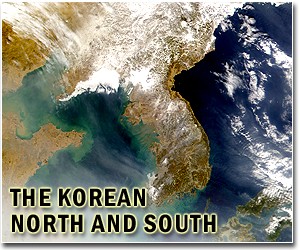
Patience with North Korea has snapped among many South Koreans and a martial mood is spreading among its leaders, military brass and public after Pyongyang's deadly artillery strikes last week.
Reflecting the popular sentiment, a grim-faced President Lee Myung-Bak in a national address Monday called the strikes "a crime against humanity" and vowed to make sure the North "pays a dear price" for any further provocations.
A new poll found that 80 percent of South Koreans think the military should have hit back harder last Tuesday, when it returned artillery fire but shied away from air strikes, said the Asan Institute for Policy Studies.
Over the years Seoul has fumed, but usually refrained from retaliating, as the regime of Kim Jong-Il staged nuclear tests, fired long-range missiles and — just weeks ago — showed off a new uranium enrichment plant.
Most South Koreans, especially the younger generations, have long shrugged off the Pyongyang's Cold War-style vitriol and verbal attacks which label them "warmongers" and "the US imperialists' puppet forces".
Agents from the North blew up a South Korean airliner in 1987, killing 115 people. Pyongyang has also been blamed by a multinational panel for the March sinking of a South Korean corvette, the Cheonan, which killed 46 sailors.
But many believe North Korea staged its most brazen provocation yet when it rained 80 shells and rockets on to the South's border island of Yeonpyeong, killing two marines and two construction workers.
The first artillery attack on a civilian area in the South since the 1950-53 war reduced two dozen buildings to smouldering ruins and sparked a panicked exodus of almost all of the island's 1,500 residents.
At the funeral for the two marines Saturday, Marine Corps commander Lieutenant General Yoo Nak-Joon vowed to "repay North Korea a hundred- and thousand-fold" for their deaths.
The government has announced it will beef up island defences, reform the military and change its rules of engagement, which have so far strongly emphasised the avoidance of escalation.
But military analysts warn that another Korean war would bring a nightmare scenario of a devastated Korean peninsula and one million deaths.
Pyongyang has claimed it only retaliated last Tuesday after its "superhuman" patience had been broken by the South firing shells into waters that the North claims as its own during an artillery drill.
Many South Koreans believe it is they who have been turning the other cheek.
Korea Policy Research Centre president Yo Ho-Yeol said: "Even until the Cheonan incident, public sentiment was still divided between criticising the North and criticising our own government's hardline stance (on the North).
"Now the public sentiment is clearly dominated by anger towards the North. And a majority of the public wants strong retaliation against the North upon any further provocation."
Daniel Pinkston, Seoul office head of the International Crisis Group, said: "The South has been pretty tolerant, but how much can you tolerate? I don't know what the red line is, but if you don't retaliate, this is giving a green light to North Korea."
Many people strongly support a joint US-South Korean naval exercise under way which is spearheaded by an American aircraft carrier, even as Pyongyang warned that the drill brought the Koreas closer to "the brink of war".
A rally against the manoeuvre drew just 20 activists Sunday, with protesters holding a banner that read: "Stop the Korea-US drill that causes a vicious cycle of retaliation and confrontation!"
Their numbers have been dwarfed by far larger anti-Pyongyang rallies.
A leading North Korea expert, Peter Beck, told AFP that it might be time for South Korea to consider military action beyond its limited response Tuesday.
"This attack is different than the Cheonan sinking," said Beck, an international affairs fellow at Keio University in Tokyo.
"There is still at least a little ambiguity about what sank the Cheonan, but this artillery strike was not only a blatant violation of the armistice agreement, it was also against civilians.
"Therefore, Seoul should consider a retaliatory strike, either on the North Korean navy or on its nuclear facilities."
Many on the streets of Seoul feel the same way.
"We should not be afraid," said 77-year-old Cheon Sang-Yong, a veteran of the Korean and Vietnam wars who now works part-time in a fast-food restaurant. "We should be prepared to fight back."
bur-ckp-jhw-fz/je
Share This Article With Planet Earth
