
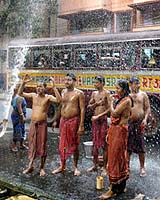
India's annual summer monsoon has arrived in the Andamans archipelago, bringing misery to homeless tsunami victims but cheer to the rest of the parched nation.
The monsoon arrived Wednesday, two days ahead of schedule, in the southern island group of Car Nicobar and was expected to hit the archipelago's Port Blair capital later Thursday, said weather office spokesman B.D. Gupta in the Andamans.
"The monsoon struck Nicobar two days ahead of schedule and is expected to reach the eastern Indian state of Orissa by June 10," Gupta said.
June 1 is the scheduled date for the onset of the monsoon in India's southernmost state of Kerala and it takes around 28 days for the rains to reach agriculture-dependent India's parched northern plains.
Naval metereologist Commander Salil Mehta reported 69 millimetres (2.76 inches) of rain Wednesday in the Nicobar group.
"The rainfall is heavy, sea conditions are bad and upper wind speeds have picked up from 10 knots to up to 30 knots (40 kilometres) per hour," he said, adding the conditions were in line with the onset of the annual summer monsoon.
The deluge brought distress for thousands living in temporary shelters built after the December 2004 tsunami battered the emerald-green archipelago.
"These are flimsy tin shelters and many of these don't even have proper floorings and this kind of rain brings in a sea of water into our homes," said Martin, a Nicobarese tribesman from Moos village.
"Added to the rains comes a variety of diseases for which the authorities are not prepared," added Aiysha Majid, chief of a nearby village.
Nicobar administrator Ranjit Singh said the situation was under control.
"The monsoon is here but such heavy rain is nothing unusual in these parts and since the shelters are in place we're not worried at all," Singh told AFP.
Indian authorities built 2,542 temporary shelters housing some 6,851 families in the island chains of Nicobar, Kamorta and Katchal that were devastated by the towering tsunami.
India's monsoon rains may be weaker than normal this year, the weather office warned in April.
The advance of the rains are keenly watched as two-thirds of India's billion-plus population earn their livelihood from agriculture, which generates a quarter of gross domestic product.
The monsoon, which accounts for about 80 percent of India's annual rainfall, sweeps the subcontinent from June to September.
