
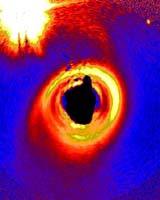
Just as anthropologists sought "the missing link" between apes and humans, astronomers are embarking on a quest for a missing link in planetary evolution. Only instead of dusty fields and worn shovels, their laboratory is the universe, and their tool of choice is NASA's new Space Infrared Telescope Facility.
Launched on Aug.25, NASA's fourth and final Great Observatory will soon set its high-tech infrared eyes on, among other celestial objects, the dusty discs surrounding stars where planets are born.
While other ground- and space-based telescopes have spied these swirling "circumstellar" discs, both young and old, they have missed middle-aged discs for various reasons. The Space Infrared Telescope Facility's unprecedented sensitivity and resolution will allow it to fill in this gap and in the process answer fundamental questions regarding how planets, including those resembling Earth, may form.
"With the Space Infrared Telescope Facility, we anticipate seeing many planetary discs at all stages of development," says Dr. Karl Stapelfeldt of JPL, a scientist with the mission. "By studying how they change over time, we may be able to determine what conditions favor planet formation."
