
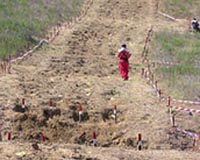
A breakthrough agreement to begin clearing Colombia, one of the most mined countries in the world, of its anti-personnel landmines will be implemented in the coming weeks, officials said Tuesday.
The agreement reached between the Colombian government and the Marxist FARC guerrillas in early March provides for disabling all anti-personnel mines in the country that were put in place during a half century of civil war.
Since 1990, mines have killed 2,000 people and wounded 9,000 more across Colombia, ranked by one watchdog as the second-worst country in the world for child landmine casualties, after Afghanistan.
"In a maximum of six weeks the country should begin to see concrete action," said former general Oscar Naranjo, a government negotiator in talks with the Revolutionary Armed Forces of Colombia (FARC).
"This is the goal I've set for myself as head of the demining plan," he said in a radio statement.
Demining operations will be conducted by security forces and guerillas in civilian clothes with the help of a Norwegian NGO.
Norway and Cuba are the guarantors of the peace talks in Havana that began in 2012.
During negotiations with the FARC, President Juan Manuel Santos estimated that at least a decade would be needed to totally rid the country of mines.
Colombian authorities signed the Ottawa Treaty in 1997 banning the use of landmines. The FARC have been heavily criticized for continuing to use the mines.
Over half of Colombia's 1,120 municipalities were potentially mined in the country's armed conflict that has involved communist guerrillas, right-wing militias, criminal gangs and the government.
The civil war has killed some 220,000 people since it began, according to official figures.
