
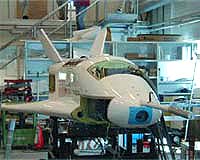
Japan will continue to pursue advances in rocket-propulsion, satellite technology and robotic exploration of the solar system, but the country has no plans to mount a major human spaceflight program.
So said Iwao Matsuda, Japan's Minister for Science and Technology, after a speech in Washington on Wednesday outlining his country's strategic research and development plans.
"Rocket technology is our most important priority," Matsuda told an audience of scientists, media and members of the international business community. "We are not so interested in (going to) the Moon and Mars – Earth is our interest."
He added, however, that Japan would work cooperatively with the United States on space-related technologies that could improve national security. "It's a political issue," he acknowledged, meaning it raises questions in the context of Japan's six decades of pacifism, "so we go, we go back, we go, we go back, but finally we go."
Invited to speak by the Washington Science Policy Alliance, Matsuda outlined his country's third five-year plan for research and development. The new plan, "Innovator Japan," which will run through 2010, calls for an investment of more than $200 billion, and establishment of 30 world-class centers for research.
Japan is committed to global leadership in research and development, Matsuda said, explaining that the effort is critical because of his country's 90 percent dependency on oil from the Middle East, and because of its declining and aging population. Otherwise, in two or three decades, Japan will lose its economic viability.
"No other country has such an urgent need to replace oil," he said, but added Japan wants to apply its science and technology advances to help solve global problems, such as climate warming and food production. "It is an obligation for us."
Matsuda said Japan's Council for Science and Technology Policy – equivalent to the White House Office of Science and Technology Policy – has chosen 62 critical research areas in which his country will attempt to achieve a competitive position. Those areas, which were chosen from an initial list of 273, include supercomputers, materials, nanotechnology, oil alternatives, and space technology.
"The sole determining factor for the continuing growth of Japan's economy is innovation," he said. "The entire Japanese government is committed to strengthening our science and technology policy."
