
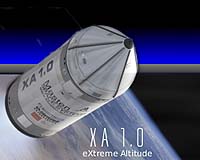
Masten Space Systems announced Wednesday that it strongly supported the recent agreement between NASA and the X Prize Foundation to develop two suborbital Centennial Challenges and that, pending announcements on rules, it looked forward to participating.
While the two new Challenges are restricted to suborbital ranges, they represent increases in altitude and technology that push the marketplace forward.
The Suborbital Payload Challenge is a prize for the first team to achieve altitudes useful to scientific research payloads, such as astronomical and atmospheric research instruments and longer-duration micro-gravity experiments. These altitudes are typically in excess of 200 kilometers and as high as 1,600 kilometers.
The Suborbital Lunar Lander Analog Challenge is a prize for the first team to fly a Vertical Take-off/Vertical Landing (VTVL) vehicle capable of reaching speeds similar to those needed to land and take-off from the moon. This usually means speeds within the Mach 5 to Mach 8 flight regime.
"Using suborbital missions like these is an extremely cost effective and low risk way of developing new launch capabilities while helping provide access to space for currently under-served markets. We are glad to see NASA embracing the X Prize Foundation and the use of prizes as a way of ensuring that private organizations can provide the advanced technology NASA will need in the future," said David Masten, company CEO.
The company was also extremely pleased with the selection of VTVL based launch method for the Lunar Analog Challenge. The company is developing a line of VTVL suborbital vehicles and foresees eventual lunar applications for its vehicle.
After NASA's announcement at last week's Countdown to the X Prize Cup, Masten said, "Obviously we have to wait until the rules are released, but from just the announcement it's something we plan on competing for and winning."
