
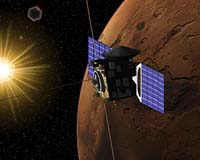
Mission Status:
Early June saw the celebration of 3 years in space for Mars-Express. Most of the summer has been spent on preparing for, and actually entering the power wise very challenging eclipse/aphelion season. The specially designed Survival Mode (SUMO) was tested and so far successfully used to safely sail through the longest eclipses.
Operations and archiving:
With the spacecraft being configured for the low-power/aphelion season, payload operations are suspended (except for one possible exception around end-September and radio science during solar conjunction) for some 10 weeks.
Early next year (Feb-Mar 2007) the default Mars Express ground station (New Norcia) will be used by Rosetta for the preparation and execution of its Mars flyby. With Cebreros being used by Venus Express and DSN availability uncertain, this will probably mean two months with lower science return for Mars Express.
A Mars-Express science working team and science operations working group meeting was held at ESOC 28-30 June 2006. One of the major topics discussed at the science working team meeting was the evolution of the Mars Express orbit, which is rapidly moving into a situation with pericenter passages predominantly happening in the dark. This could be changed to support a more balanced distribution of science possibilities over all instruments. A further meeting discussing the topic was held 31 August 2006 at ESOC.
