
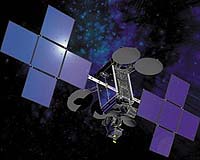
Thaicom 4 (IPSTAR), a high-power, broadband satellite built by Space Systems/Loral (SS/L) for Shin Satellite, of Thailand, was successfully launched today at 1:20 am PDT.
The satellite was put into orbit aboard an Ariane 5 rocket from the European spaceport in Kourou, French Guiana.
With a launch weight of 14,300 pounds (6486 kilograms), Thaicom 4 (IPSTAR) is the heaviest commercial satellite ever delivered to geosynchronous orbit. Thaicom 4 (IPSTAR) is designed to provide broadband services to both enterprises and consumers throughout 14 countries in the Asia-Pacific region.
"The demand for increased broadband access across the globe is a key driver in the satellite manufacturing industry," said Bernard L. Schwartz, chairman and CEO of Loral Space & Communications.
"With Thaicom 4 (IPSTAR) launched and additional satellites designed for expanded Internet access being manufactured at our Palo Alto facility, SS/L has proven itself as the leader in the development and production of these sophisticated and complex spacecraft."
The satellite has a massive total data throughput capacity of over 45 Gbps. It is designed to provide users with data speeds of up to four Mbps on the forward link and two Mbps on the return link. Thaicom 4 (IPSTAR) will use its seven on-board antennas to create 112 spot and regional beams in the Ku and Ka frequency bands. The satellite will generate 14 kW of electrical power throughout its planned 12-year service life.
Shin Satellite, a turnkey satellite operator, provides C- and Ku-band transponder leasing, teleport and other value-added and engineering services to users in Asia, Africa, Europe and Australia. Shin Satellite owns and operates Thaicom 1A, Thaicom 2 and Thaicom 3.
The satellites carry a total of 47 C-band and 20 Ku-band transponders offering over 100 channels. Thaicom is the hotbird for Indochina, an emerging platform of choice for transcontinental satellite television broadcasts from Europe to Australia.
The company has spent years researching and developing new technology to make Internet via satellite more efficient, thus reducing costs and improving the service to end-users.
