
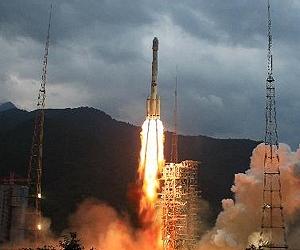
Long March-3 carrier rockets have played a crucial role in launching China's Chang'e space probes, and form a central pillar of China's overall space program. The upcoming launch of the Long March-3B will showcase updated, state-of-the-art technology and capabilities.
In 2007, the Long March-3A carrier rocket launched the Chang'e-1 satellite into space. The 2.4-ton probe circled the earth before heading to the moon, in a journey that took 12 days.
Then in 2010, the more powerful twin-booster Long-March 3C was used to carry the Chang'e-2 satellite directly to the moon in just 5 days.
The upcoming Chang'e-3 moon probe has a more complicated design and is heavier. That requires the use of the powerful Long March-3B, with its four booster rockets.
The Chang'e-3 moon probe is part of the second stage of China's three-stage lunar program. It will orbit the moon, before landing to analyze lunar soil and stone samples.
earlier related report
Carrier rocket sent to launch base for unmanned moon landing mission
A Long March-3B carrier rocket is being transported towards the Xichang Satellite Launch Center in southwest China, after left Beijing Sunday morning, to prepare for the upcoming launch of Chang'e-3 moon probe.
The carrier rocket left the capital aboard a train and is scheduled to reach the launch center on Nov. 1, said a statement from the State Administration of Science, Technology and Industry for National Defense.
Compared with the carrier rocket of Chang'e-2 moon probe, this one has been equipped with a number of new technologies and its reliability has been further improved, the statement said.
All tests on the Chang'e-3 moon probe, which has been in Xichang since Sept. 12, are going on smoothly, the statement added.
The Chang'e-3 moon probe is designed to carry China's first moon rover and soft-land on the moon. Its launch is scheduled at the end of this year.
It is part of the second stage of China's three-stage lunar probe program, orbiting, landing, and analyzing lunar soil and stone samples.
