
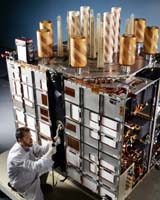
Lockheed Martin and ITT Corporation announced Wednesday the formation of a new alliance to compete to build the next generation of Global Positioning System satellites for the U.S. Air Force. Under the teaming agreement, the two companies will build on their existing partnership on the government's Block IIR and IIR-M series in which Lockheed Martin serves as the prime contractor and spacecraft integrator with ITT as the navigation payloads provider.
The new generation of satellites known as GPS Block III will address the challenging military transformational and civil needs across the globe, including advanced anti-jam capabilities and improved system security, accuracy and reliability. GPS Block III will enhance space-based navigation and performance and set a new world standard for positioning and timing services.
"We are excited to continue our long, successful partnership with ITT in providing our customer with high performance positioning and timing capabilities for both military and civil users worldwide," said Don DeGryse, vice president, Lockheed Martin Navigation Systems. "With a focus on mission success, we look forward to offering an incremental, low risk solution for the government on this critical national initiative."
The Lockheed Martin-led space segment team is currently under contract to conduct studies leading to a delta system requirements review (SRR) later this month which will further help the government define its approach to the space segment specification. A multi-billion dollar development contract is scheduled to be awarded to by the Global Positioning Systems Wing, Space and Missile Systems Center, Los Angeles Air Force Base, Calif. in 2007.
"We are confident that by fully partnering with Lockheed Martin we are best positioned to continue to provide high-performance, reliable GPS payload systems to support this national asset," said Dick Arra, vice president, ITT Space Systems Division Navigation group. "Building on more than 35 years experience and 100 percent on-orbit mission success, we're able to deliver cost effective solutions that meet today's more demanding requirements."
Today's Global Positioning System allows any properly equipped user to determine precise time and velocity and worldwide latitude, longitude and altitude to within a few meters. Although originally designed as a guidance and navigational tool for the military, GPS has proven beneficial in the commercial and civil markets for transportation, surveying and rescue operations.
