
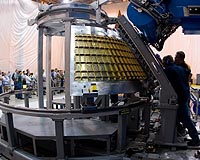
Lockheed Martin has begun its first friction stir weld process on an Orion crew module Ground Test Article at the NASA Michoud Assembly Facility in New Orleans, La.
This ground test article will serve as a production pathfinder to validate the flight vehicle production processes and tools.
When completed, this first full-sized, flight-like crew module will be tested on the ground in equivalent flight-like environments, including static vibration, acoustics and water landing loads. Results will be used to correlate sizing models for all subsystems on the vehicle.
The initial weld joined an Aluminum-Lithium (AL) 2195 cone panel and AL 2219 longeron using an innovative friction stir welding process. This high-strength, high quality welding process will be used for all crew module welds.
Weld operations on the test article will continue for approximately three months. The structure will then undergo mechanical assembly, integration and testing in New Orleans and Denver.
"Orion is applying the latest materials and manufacturing technologies, and most efficient processes to produce the lightest weight structure possible. We are excited about successfully achieving this production milestone on our critical path schedule," explained Blaine Brown, Orion Crew Module Integrated Product Team director for Lockheed Martin.
Orion weld operations take place on a Universal Weld System II (UWS II) that includes a 22-foot diameter turntable, a self-reacting friction stir weld head and a modular t-grid floor. The system affords virtually unlimited five-axis welding on fixture-mounted hardware.
The UWS II is part of the National Center for Advanced Manufacturing, managed by the University of New Orleans Foundation in partnership with NASA and the State of Louisiana.
Derek Townsend, Orion Crew Module senior manager noted "the Orion team is excited to build NASA's next generation spacecraft. This is the beginning of a new era in human space flight and America's space program.
Share This Article With Planet Earth
