
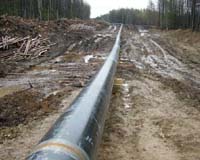
Russia on Thursday said it wanted to halt construction of an oil and gas pipeline on Sakhalin Island in the far east of the country because of the risk of landslide damage. The ministry has proposed that the project, to be run by Anglo-Dutch energy group Royal Dutch Shell, be stopped while environmental experts assess surrounding areas at risk from landslides.
"The pipeline built from the Sakhalin-2 oilfield could at any moment be damaged by landslides," Russia's natural resources ministry said in a statement.
The spokesperson for Sakhalin Energy, the consortium responsible for the project, was unavailable for comment.
Russian and international green groups have opposed the proposed pipeline because they say it will threaten whales and migrating salmon in local waters as well as disrupting fishing.
Sakhalin-2, intended to open in mid-2008, would be the first site to produce liquefied natural gas in Russia.
Mikhail Kreindlin, Greenpeace's spokesman in Russia, told Moscow Echo radio on Thursday that only a court decision could stop the pipeline construction from going ahead.
Shell has a 55 percent stake in the consortium running the project, Sakhalin Energy, while the Japanese companies Mitsui and Mitsubishi hold 25 percent and 20 percent respectively.
The first phase of the Sakhalin-2 project is partly financed by the European Bank for Reconstruction and Development. The bank is hesitating to back later phases, which would see two offshore oil platforms built and more pipelines underwater.
The Russian ministry also outlined other criticisms of the project in its statement, saying the consortium had doubled the initial costs of the project and it had suffered delays.
"It has had a negative impact on the interests of the Russian Federation because that puts off to a later date the day the state and investors will share the profits," it said in a statement.
It said that day would come, under the most optimistic scenario, in 2014.
Source: Agence France-Presse
