
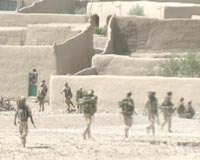
As military commanders weigh the options for the worsening war in Afghanistan, New Zealand's tiny contingent has been battling to help develop one of its safest but most backward regions.
US General Stanley McChrystal's review of the Afghan war, submitted to superiors last month, calls for a move away from killing insurgents and towards protecting civilians and developing their destitute and war-ravaged country.
While the US administration considers the merits of McChrystal's request for more troops for his nation-building plans, 130 Kiwi soldiers in central Bamiyan province have been struggling to get on with the job since 2003.
It is an immense task in the world's fifth poorest nation, where New Zealand Squadron Leader David Curry calls conditions "biblical".
"People outside Bamiyan town are living as they did 2,000 years ago, the level of development is almost biblical in its nature," said Curry, projects officer for New Zealand's Provincial Reconstruction Team (PRT).
Bamiyan — which hit international headlines in 2001 when Taliban rebels destroyed giant Buddha statues they deemed idolatrous — is one of the few provinces in Afghanistan to largely escape insurgent violence.
But that does not make development an easy task.
"We refer to it as the Bamiyan black hole — it gets ignored by the government because it's a minority area, and ignored by the coalition because it's a green (safe) area," said Curry.
Bamiyan has 40 million dollars in aid, mostly from the US, allocated for 2009/2010 — up from about 10 million dollars annually since 2003 — but Curry says it is still a drop in the ocean.
"You could sink another 100 million dollars into this province and you wouldn't notice it because it needs so much," he said.
Although not a member of NATO — which along with the US has more than 100,000 troops in Afghanistan — New Zealand is a troop contributing nation, and has small groups of elite forces elsewhere in the country.
Bamiyan is considered the safest of Afghanistan's 34 provinces, though in recent months there have been incidents of insurgent encroachment in the far north and east of the province.
Bamiyan's population of around 600,000 are mostly ethnic Hazaras, believed to be descendants of the Mongols who rampaged through the region in the 13th century, and are Shia Muslims in a largely Sunni nation.
Long discriminated against, and forced into the one of the poorest regions, they are known for their antipathy towards the Taliban, who slaughtered them in huge numbers during their 1996-2001 rule.
"People ran into the mountains to get away from the Taliban," said 60-year-old Iman Ali as he sat in his dry-goods store in the Bamiyan bazaar.
Governor Habiba Sarabi, Afghanistan's only woman provincial leader, said police arrested Mullah Borhan, a Taliban militant who had set himself up as Bamiyan's "shadow" governor for two years, just before the August 20 elections.
"He had very little support," she told AFP. "Just two bodyguards and a very small group of supporters who wanted to make trouble."
The Taliban have never gained traction in Bamiyan, and are never likely to, she said, but added: "I don't think it will be the end of their activity here."
Despite a lack of resources, abject poverty, high unemployment, subsistence farming and a dearth of infrastructure, Bamiyan has huge potential as a tourist hotspot, which forms the nucleus of Sarabi's development vision.
The province is home to the niches once occupied by the giant Gandaran Buddhas, while the azure lakes of Band-i-Amir recently became the country's first national park.
Since setting up the Bamiyan PRT, the New Zealanders have had around 140 projects ongoing at any one time — from snow ploughing to well digging and flood protection, though road building dominates.
Group Captain Greg Elliot, commander of the PRT, participates in a weekly radio programme that involves local people debating current issues — on Sunday it was the still-unresolved, fraud-ridden elections.
With good relations between the Kiwi troops and local residents, Curry said Bamiyan should be seen as a success story in a difficult war, but concedes that the results of development must be gauged over the long term.
The Taliban insurgency has steadily worsened since 2001, with 2009 the most deadly year yet for foreign troops.
"You don't win a counter-insurgency war in a year, you need time," Curry said.
"You have to learn your lessons from history and if you are trying to re-fight the last war, you're never going to win."
Share This Article With Planet Earth
