
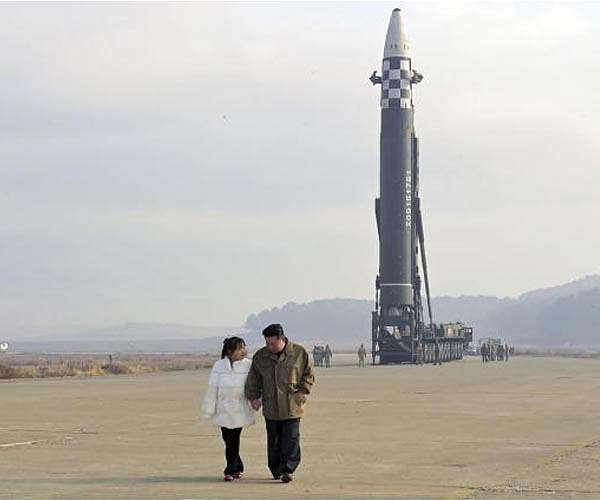
North Korean leader Kim Jong Un, accompanied by his daughter, personally oversaw the recent test-firing of the country's most powerful intercontinental ballistic missile, state media images showed Friday.
The launch on Thursday — Pyongyang's second ICBM test this year — involved a Hwasong-17 missile, the official Korean Central News Agency reported, adding that it was fired in response to "frantic" US-South Korea joint military drills.
Photographs in the official Rodong Sinmun newspaper showed Kim watching the black-and-white Hwasong-17 — dubbed a "monster missile" by analysts — blast off into the sky.
Some of the images showed him watching the launch with his daughter — never named by state media but identified as his second child Ju Ae by South Korean intelligence.
State media also released images showing the Earth from space, purportedly taken by a camera mounted on the ICBM.
KCNA said the launch "confirmed the war readiness of the ICBM unit", adding that it "had no negative impact on the security" of neighbouring countries.
South Korea had previously said the missile was fired on a lofted trajectory — up instead of out, typically done to avoid overflying neighbouring countries.
Last year, North Korea declared itself an "irreversible" nuclear power, and Kim recently called for an "exponential" increase in weapons production, including tactical nukes.
Overseeing the Thursday launch, Kim said North Korea would "react to nuclear weapons with nukes" and called for "irreversibly bolstering up the nuclear war deterrent", according to KCNA.
He also highlighted the country's "rapid response posture… to cope with any armed conflict and war", KCNA said.
– ICBM threat –
In theory, the Hwasong-17 ICBM can reach the continental United States, and with this latest launch, North Korea is trying to emphasise the advanced level of its weaponry, analysts said.
"With the photos of the Earth, Pyongyang seems to be trying to show that it can accurately hit any target the regime wants with its ICBM," Cheong Seong-chang, a senior fellow at the Sejong Institute, told AFP.
The next step will likely be North Korea firing the missile "at a normal angle", he said, which would demonstrate it can survive reentry into the atmosphere.
The Thursday launch — Pyongyang's third show of force this week — came as Tokyo and Seoul sought to thaw long-frozen ties to counter an increasingly aggressive North Korea.
South Korean President Yoon Suk Yeol flew to Japan Thursday to meet Prime Minister Fumio Kishida, the first such summit in 12 years.
North Korea fired two cruise missiles from a submarine on Sunday, followed by two short-range ballistic missiles on Thursday, as South Korea and the United States staged major military drills.
The allies have ramped up defence cooperation in the face of growing military and nuclear threats from North Korea, which has conducted a series of increasingly provocative banned weapons tests in recent months.
"The fact (that) North Korea has almost normalised ICBM tests over the last year is a concern," Joseph Dempsey, a researcher at the International Institute for Strategic Studies, told AFP.
Soo Kim, a former CIA Korea analyst, said that Kim's regime "has essentially desensitised the international community to its weapons tests," she told AFP.
"We've reached a point where an ICBM test draws no greater attention than a short-range missile test," she said.
"We'll continue to see North Korea advancing and expanding its suite of weapons capabilities in the days to come."
N.Korea says missile test-fired Thursday was an ICBM: KCNA
Seoul (AFP) March 16, 2023 –
North Korea said the projectile it test-fired Thursday was an intercontinental ballistic missile known as Hwasong-17, the state news agency KCNA reported.
The missile, whose launch was earlier reported by the government in Seoul, was fired amid "provocative and aggressive" joint military drills conducted by the United States and South Korea, the agency said Friday.
Thursday's launch was North Korea's third show of force since Sunday and took place as South Korean President Yoon Suk Yeol headed to Tokyo for a summit to boost ties in the face of Pyongyang's growing aggression.
The drill "serves as an occasion to give a stronger warning to the enemies intentionally escalating the tension in the Korean peninsula," KCNA said.
Pyongyang said the missile traveled at a maximum altitude of some 6,000 km (3,700 miles) and flew some 1,000 km (620 miles) "before accurately landing on the preset area in the open waters off the East Sea of Korea," also known as the Sea of Japan, according to the KCNA report.
The South Korean government said the missile was fired on a lofted trajectory — up instead of out, typically done to avoid overflying neighbouring countries.
Seoul and Washington have ramped up defence cooperation in the face of growing military and nuclear threats from the North, which has conducted a series of increasingly provocative banned weapons tests in recent months.
On Tuesday, North Korea fired two short-range ballistic missiles, having launched two strategic cruise missiles from a submarine Sunday, just hours before the US-South Korea exercises kicked off.
Known as Freedom Shield, the drills started Monday and are set to run for 10 days.
The Freedom Shield exercises focus on the "changing security environment" due to North Korea's redoubled aggression, the allies have said.
North Korea views all such drills as rehearsals for invasion and has repeatedly warned it would take "overwhelming" action in response.
