
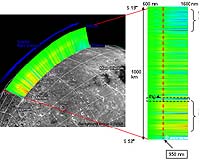
The Japan Aerospace Exploration Agency (JAXA) verified the Spectral Profiler (SP) onboard the lunar explorer "KAGUYA" (SELENE) orbiting approximately 100 km above the lunar surface, through initial observations on November 3, 2007, and subsequent data analysis. The obtained data is the world's first continuous reflectance spectra of the far side of the Moon in the visible and near infrared region.
The satellite was confirmed to be in good health through telemetry data received at the Usuda Deep Space Center.
Spectral Profiler (SP)
The Spectral Profiler (SP) is a spectrometer that can obtain continuous reflectance spectra of the lunar surface from the nadir direction of the main orbiter "KAGUYA" in a broad spectral coverage (500-2600 nm) at a high spectral resolution (6-8 nm) and high spatial resolution (500 m) [Figure 1]. It will conduct, for the first time in the world, continuous global spectral observations of the Moon in the visible to near infrared region. The initial functional check of the SP on November 3, 2007, successfully produced a series of spectra along a strip longer than 1,000 km on the far side of the Moon [Figures 2-4].
Continuous visible and near infrared reflectance spectra are to be used to precisely determine the type and breakdown of minerals on the lunar surface. Ground-based spectroscopic observations of the lunar surface are limited in area coverage to the near side of the Moon and are also in spectral and spatial resolutions due in part to the effects of the Earth's atmosphere.
Observations with historical orbiters have so far been limited in spectral coverage, restricting detailed information on the lunar surface mineral composition. With unprecedented accuracy, the Spectral Profiler performs global spectroscopic mapping of the Moon with its broad spectral coverage, and high spectral and spatial resolution, which is necessary for the determination of the type and breakdown of lunar surface minerals.
In addition, one can obtain comprehensive information on the lunar surface material by combining data from the Spectral Profiler with that taken with the Multi-band Imager (MI), which measures detailed spatial distribution of minerals, as well as that from the X-ray Spectrometer (XRS) and Gamma-ray Spectrometer (GRS), which measure spatial distribution of elements. This has led to a breakthrough in research on the formation and evolution of the Moon.
