
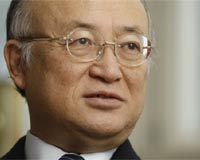
A Japanese diplomat on Tuesday held the lead in the race to become the next UN atomic watchdog chief at a time when the agency is seeking to carry out high-stakes nuclear probes in Iran and Syria.
Yukiya Amano won most votes in a non-binding "straw poll" held by the International Atomic Energy Agency in its search to find a successor to agency chief Mohamed ElBaradei, diplomats said.
Amano, Japan's ambassador to the International Atomic Energy Agency, won 20 votes out of 35, diplomats who attended the closed-door meeting.
South African ambassador Abdul Samad Minty won 11 votes and Luis Echavarri of Spain won four votes.
The two other candidates — Belgium's Jean-Pol Poncelet and Ernest Petric of Slovenia — each received no votes, the diplomats said, speaking on condition of anonymity.
The IAEA's 35-member board of governors had held the straw poll as a way of gauging support for the individual candidates.
The board is to hold a formal vote on who will succeed ElBaradei as IAEA director general on July 2.
The results of the poll are non-binding, but candidates may decide to pull out of the race if they deem support to be insufficient.
Slovenian candidate Petric said he was considering withdrawing his candidacy.
"I haven't made my mind up yet. I'll consult with government," he told reporters after the meeting.
"Had I won two, three or maybe four votes, it would be different. But with no vote, it'd be courageous to continue," he said, adding that Slovenia would reach a formal decision as to whether to pull out of the race "in the next few days."
With both Petric and Poncelet expected to withdraw, the July 2 vote looked set to be a three-man race between Amano, Minty and Echavarri, diplomats said.
Minty and Amano had stood against each other in March, but neither had been able to secure the necessary two-thirds majority on the board to win outright, with Amano perceived to be the preferred candidate of the West and Minty the favourite of developing nations.
With only four votes in the straw poll, Echavarri, too, looks unlikely to be able to bridge the gap between the industrialised and developing countries, meaning the search for ElBaradei's successor could stretch out for some time yet, diplomats said.
ElBaradei is stepping down in November after three terms, or 12 years, as IAEA Director General.
His successor will assume the highly sensitive nuclear dossiers of Syria, Iran and North Korea.
Last week, the IAEA released two new reports which showed it had made little progress in its probes into the alleged illicit nuclear activities in Iran and Syria.
Iran was still defying the UN Security Council and has so far amassed 1,339 kilogrammes of low-enriched uranium hexafluoride (UF6), the IAEA found.
In a separate report on Syria, the agency said its inspectors found uranium particles at a research reactor near Damascus that would not normally be expected there and had asked Syria to explain.
In the case of North Korea, international efforts to negotiate an end to the Pyongyang's nuclear programmes have virtually collapsed and the Stalinist state conducted what it claimed was a nuclear test last month.
ElBaradei's successor will also have to persuade IAEA member countries to contribute more money to its budget.
During his term in office, ElBaradei, who won the Nobel Peace Prize in 2005 for his work at the IAEA, has often been criticized as being too outspoken and accused of politicizing the agency.
Share This Article With Planet Earth
