
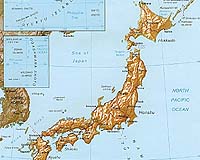
The temperature of waters around Japan has risen at a much faster rate than the rest of the world's oceans in the past century, partly because of global warming, according to an official report. Average sea temperatures in areas around Japan rose by 0.7-1.6 degress Celsius between 1900 and 2006, a higher rate than the world average of 0.5 degrees Celsius, the Japan Meteorological Agency said.
This compared with an average rise of 1.1 degrees Celsius in the temperature on the ground in Japan in the past century, the governmental agency said in its report this week.
The warmer ocean was expected to impact fish resources and the ecosystem including colonies of corals, said Yasushi Takatsuki, a marine meteorology specialist at the agency.
"It cannot be totally attributed to global warming. There are factors such as natural changes in the ocean environment. We want to check how much global warming accounts for the sea temperature rise," he said.
The findings were based on an analysis of temperatures recorded by ships, mostly merchant vessels, the report said.
A rise of 1.6 degrees Celsius was posted in the Sea of Japan, which Koreans call the East Sea, due largely to warming air over the Eurasian continent.
The UN's top scientific panel said at a meeting earlier this month that early, deep cuts in global greenhouse emissions could avert long-term climate change.
Japan was host of the Kyoto Protocol, the landmark treaty that requires cuts in greenhouse gas emissions.
